library(nabla)
#>
#> Attaching package: 'nabla'
#> The following objects are masked from 'package:stats':
#>
#>     D, deriv
Introduction
The gradient() and hessian() functions in
nabla return plain numeric vectors and
matrices — exactly what R’s built-in optimizers expect. This
vignette shows how to plug AD derivatives into optim() and
nlminb() for optimization.
The integration pattern:
# optim() with AD gradient
optim(start, fn = nll, gr = ngr, method = "BFGS")

# nlminb() with AD gradient + Hessian
nlminb(start, objective = nll, gradient = ngr, hessian = nhess)
Sign convention: Both optim() and
nlminb() minimize. For maximization (e.g.,
MLE), negate everything:
fn = function(x) -f(x)gr = function(x) -gradient(f, x)hessian = function(x) -hessian(f, x)
Key difference between optimizers:
optim() |
nlminb() |
|
|---|---|---|
| Gradient function |
gr argument (used during optimization) |
gradient argument |
| Hessian function | Not supported — hessian=TRUE only computes it
after convergence |
hessian argument (used during optimization) |
| Best use | BFGS with AD gradient | Full second-order optimization |
optim() with AD gradients
Let’s fit a
Normal(,
)
model using optim(). First, define the log-likelihood with
sufficient statistics:
set.seed(42)
data_norm <- rnorm(100, mean = 5, sd = 2)
n <- length(data_norm)
sum_x <- sum(data_norm)
sum_x2 <- sum(data_norm^2)

ll_normal <- function(x) {
  mu <- x[1]
  sigma <- exp(x[2])  # unconstrained: x[2] = log(sigma)
  -n * log(sigma) - (1 / (2 * sigma^2)) * (sum_x2 - 2 * mu * sum_x + n * mu^2)
}
Reparameterization. Because
,
we optimize over
so that the parameter space is fully unconstrained — a standard practice
in optimization. Without this, BFGS can step
through zero, producing NaN from log(sigma)
and causing divergence. The AD chain rule propagates through
exp() automatically, so gradient() and
hessian() return derivatives with respect to
without any manual Jacobian adjustment.
Now compare BFGS with and without the AD gradient:
# Negated versions for minimization
nll <- function(x) -ll_normal(x)
ngr <- function(x) -gradient(ll_normal, x)

# Starting value: mu = 0, log(sigma) = 0 (i.e., sigma = 1)
start <- c(0, 0)

# Without gradient: optim uses internal finite differences
fit_no_gr <- optim(start, fn = nll, method = "BFGS")

# With AD gradient
fit_ad_gr <- optim(start, fn = nll, gr = ngr, method = "BFGS")

# Compare (transform x[2] back to sigma for display)
data.frame(
  method = c("BFGS (no gradient)", "BFGS (AD gradient)"),
  mu = c(fit_no_gr$par[1], fit_ad_gr$par[1]),
  sigma = exp(c(fit_no_gr$par[2], fit_ad_gr$par[2])),
  fn_calls = c(fit_no_gr$counts["function"], fit_ad_gr$counts["function"]),
  gr_calls = c(fit_no_gr$counts["gradient"], fit_ad_gr$counts["gradient"]),
  convergence = c(fit_no_gr$convergence, fit_ad_gr$convergence)
)
#>               method       mu    sigma fn_calls gr_calls convergence
#> 1 BFGS (no gradient) 5.065079 2.072403       39       16           0
#> 2 BFGS (AD gradient) 5.065088 2.072401       39       16           0
Both reach the same optimum, but the AD gradient version typically uses fewer function evaluations because it has exact gradient information.
# Verify against analytical MLE
mle_mu <- mean(data_norm)
mle_sigma <- sqrt(mean((data_norm - mle_mu)^2))
cat("Analytical MLE: mu =", round(mle_mu, 6), " sigma =", round(mle_sigma, 6), "\n")
#> Analytical MLE: mu = 5.06503  sigma = 2.072274
cat("optim+AD MLE:   mu =", round(fit_ad_gr$par[1], 6),
    " sigma =", round(exp(fit_ad_gr$par[2]), 6), "\n")
#> optim+AD MLE:   mu = 5.065088  sigma = 2.072401
nlminb() with AD gradient + Hessian
nlminb() is the only base R optimizer that accepts a
Hessian function argument, making it the natural target
for second-order AD:
nhess <- function(x) -hessian(ll_normal, x)

fit_nlminb <- nlminb(start,
                     objective = nll,
                     gradient = ngr,
                     hessian = nhess)

cat("nlminb MLE: mu =", round(fit_nlminb$par[1], 6),
    " sigma =", round(exp(fit_nlminb$par[2]), 6), "\n")
#> nlminb MLE: mu = 5.06503  sigma = 2.072274
cat("Converged:", fit_nlminb$convergence == 0, "\n")
#> Converged: TRUE
cat("Iterations:", fit_nlminb$iterations, "\n")
#> Iterations: 8
cat("Function evaluations:", fit_nlminb$evaluations["function"], "\n")
#> Function evaluations: 10
cat("Gradient evaluations:", fit_nlminb$evaluations["gradient"], "\n")
#> Gradient evaluations: 9
With exact Hessian information, nlminb() can achieve
faster convergence than quasi-Newton methods (like BFGS) that
approximate the Hessian from gradient history.
Logistic regression example
To demonstrate multi-parameter optimization, let’s fit a logistic
regression and compare with R’s glm():
# Simulate data
set.seed(7)
n_lr <- 200
x1 <- rnorm(n_lr)
x2 <- rnorm(n_lr)
X <- cbind(1, x1, x2)
beta_true <- c(-0.5, 1.2, -0.8)
eta_true <- X %*% beta_true
prob_true <- 1 / (1 + exp(-eta_true))
y <- rbinom(n_lr, 1, prob_true)

# Log-likelihood for nabla
ll_logistic <- function(x) {
  result <- dual_constant(0)
  for (i in seq_len(n_lr)) {
    eta_i <- x[1] * X[i, 1] + x[2] * X[i, 2] + x[3] * X[i, 3]
    result <- result + y[i] * eta_i - log(1 + exp(eta_i))
  }
  result
}

# Numeric version for optim's fn
ll_logistic_num <- function(beta) {
  eta <- X %*% beta
  sum(y * eta - log(1 + exp(eta)))
}
Fit with optim() using the AD gradient:
nll_lr <- function(x) -ll_logistic_num(x)
ngr_lr <- function(x) -gradient(ll_logistic, x)

fit_lr <- optim(c(0, 0, 0), fn = nll_lr, gr = ngr_lr, method = "BFGS")
Compare with glm():
fit_glm <- glm(y ~ x1 + x2, family = binomial)

# Coefficient comparison
data.frame(
  parameter = c("Intercept", "x1", "x2"),
  optim_AD = round(fit_lr$par, 6),
  glm = round(coef(fit_glm), 6),
  difference = round(fit_lr$par - coef(fit_glm), 10)
)
#>             parameter  optim_AD       glm  difference
#> (Intercept) Intercept -0.703586 -0.703587  1.5805e-06
#> x1                 x1  1.345038  1.345043 -5.7000e-06
#> x2                 x2 -0.881894 -0.881896  2.3194e-06
The AD-based optimizer recovers the same coefficients as
glm().
Standard errors from the Hessian
After optimization, the observed information matrix (negative Hessian at the optimum) provides the asymptotic variance-covariance matrix:
# Observed information at the optimum (negative Hessian)
obs_info <- -hessian(ll_logistic, fit_lr$par)

# Variance-covariance matrix
vcov_ad <- solve(obs_info)

# Standard errors
se_ad <- sqrt(diag(vcov_ad))

# Compare with glm's standard errors
se_glm <- summary(fit_glm)$coefficients[, "Std. Error"]

data.frame(
  parameter = c("Intercept", "x1", "x2"),
  SE_AD = round(se_ad, 6),
  SE_glm = round(se_glm, 6),
  ratio = round(se_ad / se_glm, 8)
)
#>             parameter    SE_AD   SE_glm    ratio
#> (Intercept) Intercept 0.186306 0.186293 1.000069
#> x1                 x1 0.228300 0.228277 1.000101
#> x2                 x2 0.188825 0.188810 1.000077
The standard errors from AD’s exact Hessian match
glm()’s Fisher-scoring estimates closely (the ratio should
be very near 1.0).
Convergence comparison
Let’s compare how many iterations each optimizer strategy needs by tracking the negative log-likelihood at each step:
# Track convergence for three methods on the Normal(mu, sigma) model
# We'll use a callback-style approach via optim's trace

# Method 1: Nelder-Mead (no gradient)
fit_nm <- optim(start, fn = nll, method = "Nelder-Mead",
                control = list(maxit = 200))

# Method 2: BFGS with AD gradient
fit_bfgs <- optim(start, fn = nll, gr = ngr, method = "BFGS")

# Method 3: nlminb with AD gradient + Hessian
fit_nlm <- nlminb(start, objective = nll, gradient = ngr, hessian = nhess)

# Summary comparison
data.frame(
  method = c("Nelder-Mead", "BFGS + AD grad", "nlminb + AD grad+hess"),
  fn_evals = c(fit_nm$counts["function"],
               fit_bfgs$counts["function"],
               fit_nlm$evaluations["function"]),
  converged = c(fit_nm$convergence == 0,
                fit_bfgs$convergence == 0,
                fit_nlm$convergence == 0),
  nll = c(fit_nm$value, fit_bfgs$value, fit_nlm$objective)
)
#>                  method fn_evals converged      nll
#> 1           Nelder-Mead       99      TRUE 122.8647
#> 2        BFGS + AD grad       39      TRUE 122.8647
#> 3 nlminb + AD grad+hess       10      TRUE 122.8647
# Contour plot with optimizer paths
# Recompute paths by running each optimizer and collecting iterates

# Helper: collect iterates via BFGS
bfgs_trace <- list()
bfgs_nll <- function(x) {
  bfgs_trace[[length(bfgs_trace) + 1L]] <<- x
  -ll_normal(x)
}
bfgs_trace <- list()
optim(start, fn = bfgs_nll, gr = ngr, method = "BFGS")
#> $par
#> [1] 5.0650877 0.7287078
#>
#> $value
#> [1] 122.8647
#>
#> $counts
#> function gradient
#>       39       16
#>
#> $convergence
#> [1] 0
#>
#> $message
#> NULL
bfgs_path <- do.call(rbind, bfgs_trace)

# Helper: collect iterates via Nelder-Mead
nm_trace <- list()
nm_nll <- function(x) {
  nm_trace[[length(nm_trace) + 1L]] <<- x
  -ll_normal(x)
}
nm_trace <- list()
optim(start, fn = nm_nll, method = "Nelder-Mead",
      control = list(maxit = 200))
#> $par
#> [1] 5.0655326 0.7286854
#>
#> $value
#> [1] 122.8647
#>
#> $counts
#> function gradient
#>       99       NA
#>
#> $convergence
#> [1] 0
#>
#> $message
#> NULL
nm_path <- do.call(rbind, nm_trace)

# Helper: collect iterates via nlminb
nlm_trace <- list()
nlm_nll <- function(x) {
  nlm_trace[[length(nlm_trace) + 1L]] <<- x
  -ll_normal(x)
}
nlm_trace <- list()
nlminb(start, objective = nlm_nll, gradient = ngr, hessian = nhess)
#> $par
#> [1] 5.0650296 0.7286466
#>
#> $objective
#> [1] 122.8647
#>
#> $convergence
#> [1] 0
#>
#> $iterations
#> [1] 8
#>
#> $evaluations
#> function gradient
#>       10        9
#>
#> $message
#> [1] "relative convergence (4)"
nlm_path <- do.call(rbind, nlm_trace)

# Build contour grid
mu_grid <- seq(-1, 7, length.out = 100)
sigma_grid <- seq(0.5, 4, length.out = 100)
nll_surface <- outer(mu_grid, sigma_grid, Vectorize(function(m, s) {
  -ll_normal(c(m, log(s)))
}))

# Transform paths from (mu, log_sigma) to (mu, sigma) for plotting
bfgs_path[, 2] <- exp(bfgs_path[, 2])
nm_path[, 2] <- exp(nm_path[, 2])
nlm_path[, 2] <- exp(nlm_path[, 2])

par(mar = c(4, 4, 2, 1))
contour(mu_grid, sigma_grid, nll_surface, nlevels = 30,
        xlab = expression(mu), ylab = expression(sigma),
        main = "Optimizer paths on NLL contours",
        col = "grey75")

# Nelder-Mead path (subsample for clarity)
nm_sub <- nm_path[seq(1, nrow(nm_path), length.out = min(50, nrow(nm_path))), ]
lines(nm_sub[, 1], nm_sub[, 2], col = "coral", lwd = 1.5, lty = 3)
points(nm_sub[1, 1], nm_sub[1, 2], pch = 17, col = "coral", cex = 1.2)

# BFGS path
lines(bfgs_path[, 1], bfgs_path[, 2], col = "steelblue", lwd = 2, type = "o",
      pch = 19, cex = 0.6)

# nlminb path
lines(nlm_path[, 1], nlm_path[, 2], col = "forestgreen", lwd = 2, type = "o",
      pch = 15, cex = 0.6)

# MLE
points(mle_mu, mle_sigma, pch = 3, col = "black", cex = 2, lwd = 2)

legend("topright",
       legend = c("Nelder-Mead", "BFGS + AD grad", "nlminb + AD grad+hess", "MLE"),
       col = c("coral", "steelblue", "forestgreen", "black"),
       lty = c(3, 1, 1, NA), pch = c(17, 19, 15, 3),
       lwd = c(1.5, 2, 2, 2), bty = "n", cex = 0.85)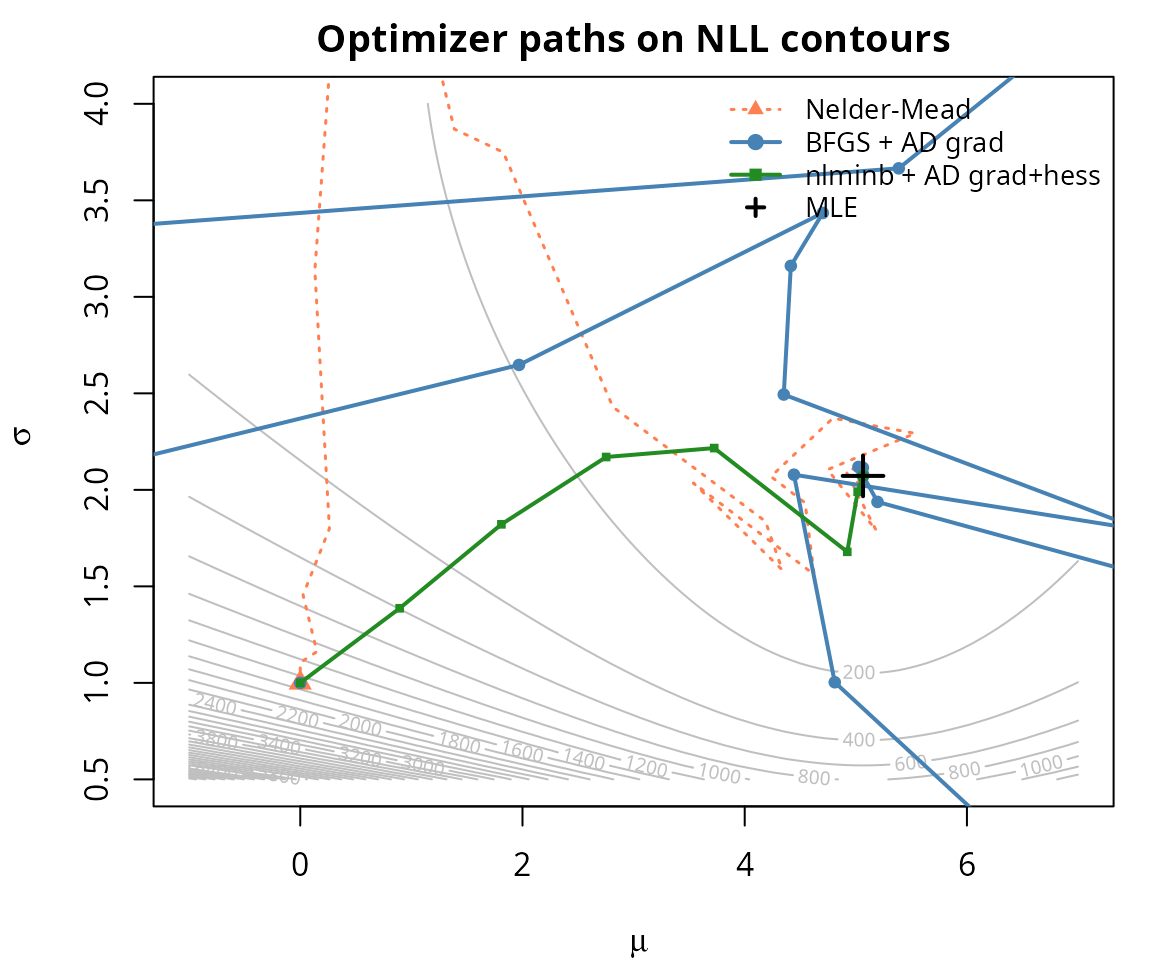
The Nelder-Mead simplex method (no derivatives) requires many more
function evaluations and takes a wandering path. BFGS with the AD
gradient converges more efficiently. nlminb() with both
gradient and Hessian can achieve the most direct path to the
optimum.
Summary
| What you need | Function | R optimizer argument |
|---|---|---|
| Gradient | gradient(f, x) |
gr in optim(), gradient in
nlminb()
|
| Hessian | hessian(f, x) |
hessian in nlminb() only |
| Observed information | -hessian(f, x) |
Post-optimization: invert for SEs |
When to use which optimizer:
-
optim()with BFGS — good default; usegr = function(x) -gradient(f, x) -
nlminb()— when you want second-order convergence; supply both gradient and Hessian - Nelder-Mead — fallback for non-smooth objectives; doesn’t benefit from AD
Remember the sign convention: optimizers minimize. For maximization, negate the function, gradient, and Hessian when passing to the optimizer.