library(nabla)
#>
#> Attaching package: 'nabla'
#> The following objects are masked from 'package:stats':
#>
#>     D, deriv
This vignette demonstrates nabla’s
gradient() and hessian() functions on several
functions. For each, we compare derivatives computed three ways:
- Analytical — hand-derived formulas
- Finite differences — numerical approximation
-
AD (nabla) — automatic differentiation via
gradient()andhessian()
Helper: finite difference utilities
We’ll use central differences for numerical comparison:
numerical_gradient <- function(f, x, h = 1e-7) {
  p <- length(x)
  grad <- numeric(p)
  for (i in seq_len(p)) {
    x_plus <- x_minus <- x
    x_plus[i] <- x[i] + h
    x_minus[i] <- x[i] - h
    grad[i] <- (f(x_plus) - f(x_minus)) / (2 * h)
  }
  grad
}

numerical_hessian <- function(f, x, h = 1e-5) {
  p <- length(x)
  H <- matrix(0, nrow = p, ncol = p)
  for (i in seq_len(p)) {
    for (j in seq_len(i)) {
      x_pp <- x_pm <- x_mp <- x_mm <- x
      x_pp[i] <- x_pp[i] + h; x_pp[j] <- x_pp[j] + h
      x_pm[i] <- x_pm[i] + h; x_pm[j] <- x_pm[j] - h
      x_mp[i] <- x_mp[i] - h; x_mp[j] <- x_mp[j] + h
      x_mm[i] <- x_mm[i] - h; x_mm[j] <- x_mm[j] - h
      H[i, j] <- (f(x_pp) - f(x_pm) - f(x_mp) + f(x_mm)) / (4 * h * h)
      H[j, i] <- H[i, j]
    }
  }
  H
}
Normal log-likelihood: known sigma, unknown mu
A simple starting example. Given data with known , the log-likelihood for is:
Using sufficient statistics (, ), this simplifies.
set.seed(42)
data_norm <- rnorm(100, mean = 5, sd = 2)
n <- length(data_norm)
sigma <- 2
sum_x <- sum(data_norm)
sum_x2 <- sum(data_norm^2)

ll_normal_mu <- function(x) {
  mu <- x[1]
  -1 / (2 * sigma^2) * (sum_x2 - 2 * mu * sum_x + n * mu^2)
}

# Evaluate at mu = 4.5
mu0 <- 4.5

# AD gradient and Hessian
ad_grad <- gradient(ll_normal_mu, mu0)
ad_hess <- hessian(ll_normal_mu, mu0)

# Analytical: gradient = (sum_x - n*mu)/sigma^2, Hessian = -n/sigma^2
xbar <- mean(data_norm)
analytical_grad <- (sum_x - n * mu0) / sigma^2
analytical_hess <- -n / sigma^2

# Numerical
num_grad <- numerical_gradient(ll_normal_mu, mu0)
num_hess <- numerical_hessian(ll_normal_mu, mu0)

# Three-way comparison: Gradient
data.frame(
  method = c("Analytical", "Finite Diff", "AD"),
  gradient = c(analytical_grad, num_grad, ad_grad)
)
#>        method gradient
#> 1  Analytical 14.12574
#> 2 Finite Diff 14.12574
#> 3          AD 14.12574

# Three-way comparison: Hessian
data.frame(
  method = c("Analytical", "Finite Diff", "AD"),
  hessian = c(analytical_hess, num_hess, ad_hess)
)
#>        method   hessian
#> 1  Analytical -25.00000
#> 2 Finite Diff -24.99974
#> 3          AD -25.00000
All three methods agree to machine precision for this simple quadratic function. The gradient is linear in and the Hessian is constant (), so there are no higher-order terms for finite differences to approximate poorly. This serves as a sanity check that the AD machinery is wired correctly.
The observed information (negative Hessian) is simply:
obs_info <- -hessian(ll_normal_mu, mu0)
obs_info  # should equal n/sigma^2 = 25
#>      [,1]
#> [1,]   25
Normal log-likelihood: unknown mu and sigma
Now both and are unknown. The log-likelihood is:
ll_normal_2 <- function(x) {
  mu <- x[1]
  sigma <- x[2]
  -n * log(sigma) - (1 / (2 * sigma^2)) * (sum_x2 - 2 * mu * sum_x + n * mu^2)
}

theta0 <- c(4.5, 1.8)

# AD
ad_grad2 <- gradient(ll_normal_2, theta0)
ad_hess2 <- hessian(ll_normal_2, theta0)

# Analytical gradient:
# d/dmu = n*(xbar - mu)/sigma^2
# d/dsigma = -n/sigma + (1/sigma^3)*sum((xi - mu)^2)
mu0_2 <- theta0[1]; sigma0_2 <- theta0[2]
ss <- sum_x2 - 2 * mu0_2 * sum_x + n * mu0_2^2  # sum of (xi - mu)^2
analytical_grad2 <- c(
  n * (xbar - mu0_2) / sigma0_2^2,
  -n / sigma0_2 + ss / sigma0_2^3
)

# Analytical Hessian:
# d2/dmu2 = -n/sigma^2
# d2/dsigma2 = n/sigma^2 - 3*ss/sigma^4
# d2/dmu.dsigma = -2*n*(xbar - mu)/sigma^3
analytical_hess2 <- matrix(c(
  -n / sigma0_2^2,
  -2 * n * (xbar - mu0_2) / sigma0_2^3,
  -2 * n * (xbar - mu0_2) / sigma0_2^3,
  n / sigma0_2^2 - 3 * ss / sigma0_2^4
), nrow = 2, byrow = TRUE)

# Numerical
num_grad2 <- numerical_gradient(ll_normal_2, theta0)
num_hess2 <- numerical_hessian(ll_normal_2, theta0)

# Gradient comparison
data.frame(
  parameter = c("mu", "sigma"),
  analytical = analytical_grad2,
  finite_diff = num_grad2,
  AD = ad_grad2
)
#>   parameter analytical finite_diff       AD
#> 1        mu   17.43919    17.43919 17.43919
#> 2     sigma   23.55245    23.55245 23.55245

# Hessian comparison (flatten for display)
cat("AD Hessian:\n")
#> AD Hessian:
ad_hess2
#>           [,1]       [,2]
#> [1,] -30.86420  -19.37687
#> [2,] -19.37687 -100.98248
cat("\nAnalytical Hessian:\n")
#>
#> Analytical Hessian:
analytical_hess2
#>           [,1]       [,2]
#> [1,] -30.86420  -19.37687
#> [2,] -19.37687 -100.98248
cat("\nMax absolute difference:", max(abs(ad_hess2 - analytical_hess2)), "\n")
#>
#> Max absolute difference: 2.842171e-14
The maximum absolute difference between the AD and analytical Hessians is at the level of machine epsilon (), confirming that AD computes exact second derivatives even for this two-parameter model. The cross-derivative is non-zero when , exercising the mixed-partial logic in nested dual arithmetic.
Poisson log-likelihood: unknown lambda
Given count data from Poisson():
set.seed(123)
data_pois <- rpois(80, lambda = 3.5)
n_pois <- length(data_pois)
sum_x_pois <- sum(data_pois)
sum_lfact <- sum(lfactorial(data_pois))

ll_poisson <- function(x) {
  lambda <- x[1]
  sum_x_pois * log(lambda) - n_pois * lambda - sum_lfact
}

lam0 <- 3.0

# AD
ad_grad_p <- gradient(ll_poisson, lam0)
ad_hess_p <- hessian(ll_poisson, lam0)

# Analytical: gradient = sum_x/lambda - n, Hessian = -sum_x/lambda^2
analytical_grad_p <- sum_x_pois / lam0 - n_pois
analytical_hess_p <- -sum_x_pois / lam0^2

# Numerical
num_grad_p <- numerical_gradient(ll_poisson, lam0)
num_hess_p <- numerical_hessian(ll_poisson, lam0)

data.frame(
  quantity = c("Gradient", "Hessian"),
  analytical = c(analytical_grad_p, analytical_hess_p),
  finite_diff = c(num_grad_p, num_hess_p),
  AD = c(ad_grad_p, ad_hess_p)
)
#>   quantity analytical finite_diff        AD
#> 1 Gradient   13.66667    13.66667  13.66667
#> 2  Hessian  -31.22222   -31.22238 -31.22222
Again, all three methods agree exactly. The Poisson log-likelihood
involves only log(lambda) and linear terms in
,
so the sufficient statistics produce clean rational expressions for the
gradient and Hessian — making this an ideal test case for verifying AD
correctness.
Visualizing the gradient
The gradient of a function is zero at its optimum. We can see this by plotting the log-likelihood and its gradient together:
lam_grid <- seq(2.0, 5.5, length.out = 200)

# Compute log-likelihood and gradient over the grid
ll_vals <- sapply(lam_grid, function(l) ll_poisson(l))
gr_vals <- sapply(lam_grid, function(l) gradient(ll_poisson, l))

mle_lam <- sum_x_pois / n_pois  # analytical MLE

par(mar = c(4, 4.5, 2, 4.5))
plot(lam_grid, ll_vals, type = "l", col = "steelblue", lwd = 2,
     xlab = expression(lambda), ylab = expression(ell(lambda)),
     main = "Poisson log-likelihood and gradient")
par(new = TRUE)
plot(lam_grid, gr_vals, type = "l", col = "firebrick", lwd = 2, lty = 2,
     axes = FALSE, xlab = "", ylab = "")
axis(4, col.axis = "firebrick")
mtext("Gradient", side = 4, line = 2.5, col = "firebrick")
abline(h = 0, col = "grey60", lty = 3)
abline(v = mle_lam, col = "grey40", lty = 3)
points(mle_lam, 0, pch = 4, col = "firebrick", cex = 1.5, lwd = 2)
legend("topright",
       legend = c(expression(ell(lambda)), "Gradient", "MLE"),
       col = c("steelblue", "firebrick", "grey40"),
       lty = c(1, 2, 3), lwd = c(2, 2, 1), pch = c(NA, NA, 4),
       bty = "n")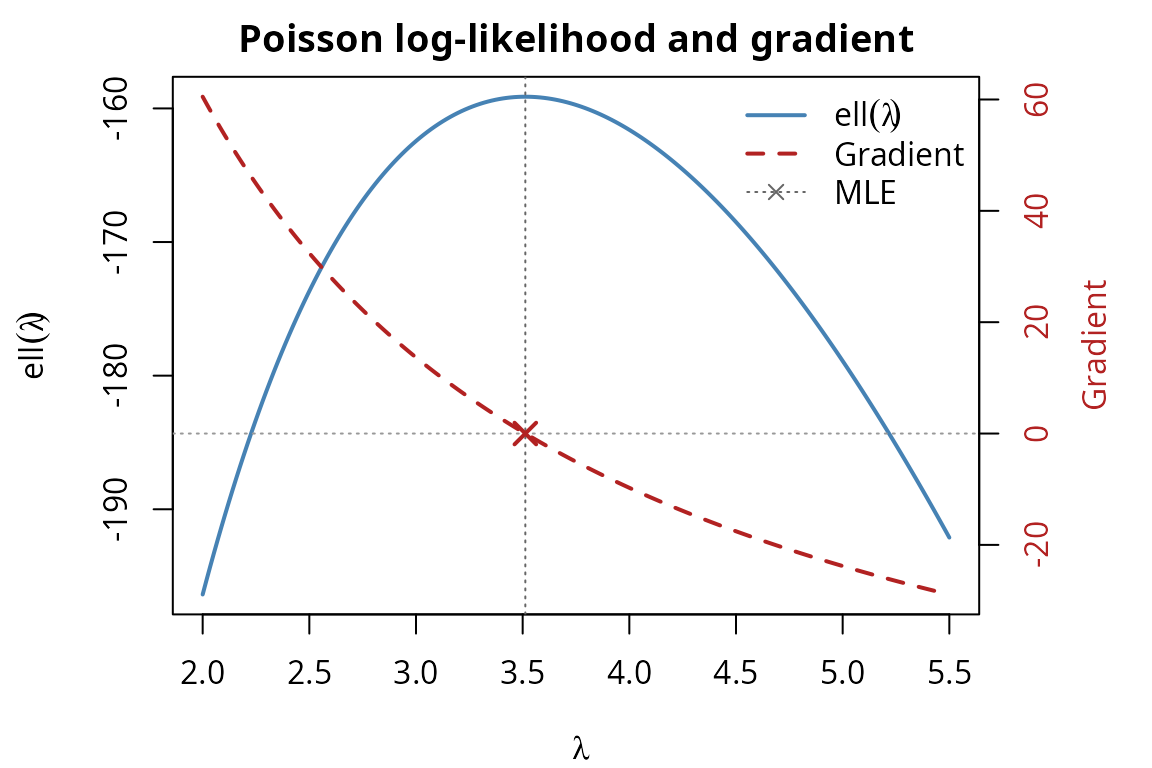
The gradient crosses zero exactly at the MLE (), confirming that our AD-computed gradient is consistent with the analytical solution.
Gamma log-likelihood: unknown shape, known rate
The Gamma distribution with shape and known rate has log-likelihood:
This is interesting because it involves lgamma and
digamma.
set.seed(99)
data_gamma <- rgamma(60, shape = 2.5, rate = 1)
n_gam <- length(data_gamma)
sum_log_x <- sum(log(data_gamma))
sum_x_gam <- sum(data_gamma)
beta_known <- 1

ll_gamma <- function(x) {
  alpha <- x[1]
  (alpha - 1) * sum_log_x - n_gam * lgamma(alpha) +
    n_gam * alpha * log(beta_known) - beta_known * sum_x_gam
}

alpha0 <- 2.0

# AD
ad_grad_g <- gradient(ll_gamma, alpha0)
ad_hess_g <- hessian(ll_gamma, alpha0)

# Analytical: gradient = sum_log_x - n*digamma(alpha) + n*log(beta)
# Hessian = -n*trigamma(alpha)
analytical_grad_g <- sum_log_x - n_gam * digamma(alpha0) + n_gam * log(beta_known)
analytical_hess_g <- -n_gam * trigamma(alpha0)

# Numerical
num_grad_g <- numerical_gradient(ll_gamma, alpha0)
num_hess_g <- numerical_hessian(ll_gamma, alpha0)

data.frame(
  quantity = c("Gradient", "Hessian"),
  analytical = c(analytical_grad_g, analytical_hess_g),
  finite_diff = c(num_grad_g, num_hess_g),
  AD = c(ad_grad_g, ad_hess_g)
)
#>   quantity analytical finite_diff        AD
#> 1 Gradient   16.97943    16.97943  16.97943
#> 2  Hessian  -38.69604   -38.69602 -38.69604
The Gamma model is a key differentiator between AD and finite
differences. The log-likelihood involves lgamma(alpha),
whose derivatives are digamma and trigamma —
special functions that nabla propagates exactly through the
chain rule. With finite differences, choosing a good step size
for lgamma is tricky: too large introduces truncation error
in the rapidly-varying digamma function, too small amplifies round-off.
AD sidesteps this entirely by computing the exact digamma
and trigamma values at each evaluation point.
Logistic regression: 2 predictors
For a binary response with design matrix and coefficients :
set.seed(7)
n_lr <- 50
X <- cbind(1, rnorm(n_lr), rnorm(n_lr))  # intercept + 2 predictors
beta_true <- c(-0.5, 1.2, -0.8)
eta_true <- X %*% beta_true
prob_true <- 1 / (1 + exp(-eta_true))
y <- rbinom(n_lr, 1, prob_true)

ll_logistic <- function(x) {
  result <- dual_constant(0)
  for (i in seq_len(n_lr)) {
    eta_i <- x[1] * X[i, 1] + x[2] * X[i, 2] + x[3] * X[i, 3]
    result <- result + y[i] * eta_i - log(1 + exp(eta_i))
  }
  result
}

beta0 <- c(0, 0, 0)

# AD
ad_grad_lr <- gradient(ll_logistic, beta0)
ad_hess_lr <- hessian(ll_logistic, beta0)

# Numerical
ll_logistic_num <- function(beta) {
  eta <- X %*% beta
  sum(y * eta - log(1 + exp(eta)))
}
num_grad_lr <- numerical_gradient(ll_logistic_num, beta0)
num_hess_lr <- numerical_hessian(ll_logistic_num, beta0)

# Gradient comparison
data.frame(
  parameter = c("beta0", "beta1", "beta2"),
  finite_diff = num_grad_lr,
  AD = ad_grad_lr,
  difference = ad_grad_lr - num_grad_lr
)
#>   parameter finite_diff        AD    difference
#> 1     beta0    -2.00000  -2.00000 -1.215494e-08
#> 2     beta1    11.10628  11.10628 -7.302688e-09
#> 3     beta2   -10.28118 -10.28118  2.067073e-08

# Hessian comparison
cat("Max |AD - numerical| in Hessian:", max(abs(ad_hess_lr - num_hess_lr)), "\n")
#> Max |AD - numerical| in Hessian: 2.56111e-05
The numerical Hessian difference () is noticeably larger than in the earlier models. This is because the logistic log-likelihood is computed via a loop over observations, and each finite-difference perturbation accumulates small errors across all iterations. AD remains exact regardless of the number of loop iterations — each arithmetic operation propagates derivatives without approximation.
Newton-Raphson optimizer
We can build a simple optimizer using gradient() and
hessian() directly. Newton-Raphson updates:
where
is the gradient and
is the Hessian.
newton_raphson <- function(f, theta0, tol = 1e-8, max_iter = 50) {
  theta <- theta0
  for (iter in seq_len(max_iter)) {
    g <- gradient(f, theta)
    H <- hessian(f, theta)
    step <- solve(H, g)
    theta <- theta - step
    if (max(abs(g)) < tol) break
  }
  list(estimate = theta, iterations = iter, gradient = g)
}

# Apply to Normal(mu, sigma) model
result_nr <- newton_raphson(ll_normal_2, c(3, 1))
result_nr$estimate
#> [1] 5.065030 2.072274
result_nr$iterations
#> [1] 10

# Compare with analytical MLE
mle_mu <- mean(data_norm)
mle_sigma <- sqrt(mean((data_norm - mle_mu)^2))  # MLE (not sd())
cat("NR estimate:    mu =", result_nr$estimate[1], " sigma =", result_nr$estimate[2], "\n")
#> NR estimate:    mu = 5.06503  sigma = 2.072274
cat("Analytical MLE: mu =", mle_mu, " sigma =", mle_sigma, "\n")
#> Analytical MLE: mu = 5.06503  sigma = 2.072274
cat("Max difference:", max(abs(result_nr$estimate - c(mle_mu, mle_sigma))), "\n")
#> Max difference: 1.776357e-15
Contour plot: Normal(mu, sigma) log-likelihood surface
The two-parameter Normal model has a log-likelihood surface we can visualize with contours. The MLE sits at the peak:
mu_grid <- seq(4.0, 6.0, length.out = 80)
sigma_grid <- seq(1.2, 2.8, length.out = 80)

# Evaluate log-likelihood on the grid
ll_surface <- outer(mu_grid, sigma_grid, Vectorize(function(m, s) {
  ll_normal_2(c(m, s))
}))

par(mar = c(4, 4, 2, 1))
contour(mu_grid, sigma_grid, ll_surface, nlevels = 25,
        xlab = expression(mu), ylab = expression(sigma),
        main = expression("Log-likelihood contours: Normal(" * mu * ", " * sigma * ")"),
        col = "steelblue")
points(mle_mu, mle_sigma, pch = 3, col = "firebrick", cex = 2, lwd = 2)
text(mle_mu + 0.15, mle_sigma, "MLE", col = "firebrick", cex = 0.9)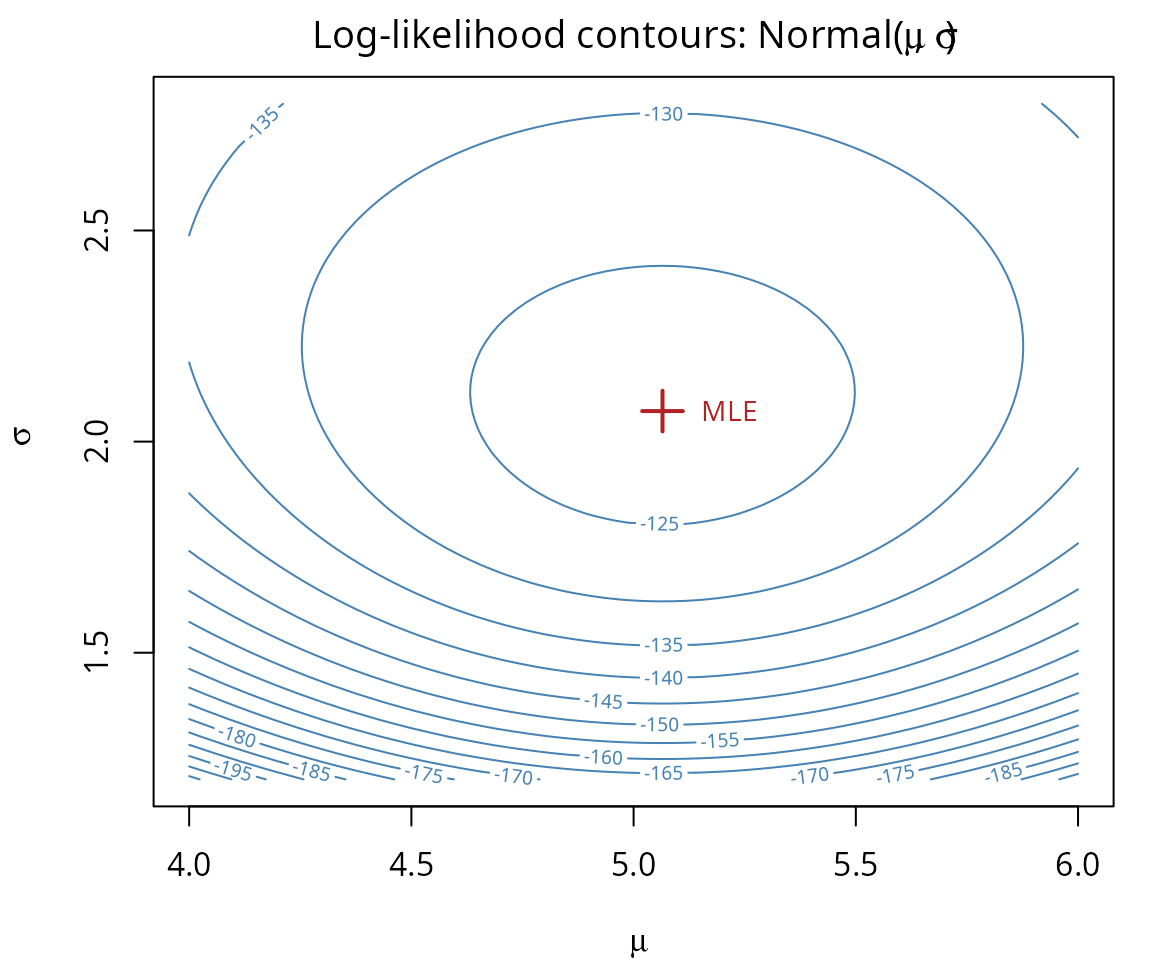
Newton-Raphson convergence path
We can visualize how Newton-Raphson converges to the MLE by recording the parameter estimates at each iteration and overlaying them on the contour plot:
# Newton-Raphson with trace
newton_raphson_trace <- function(f, theta0, tol = 1e-8, max_iter = 50) {
  theta <- theta0
  trace <- list(theta)
  for (iter in seq_len(max_iter)) {
    g <- gradient(f, theta)
    H <- hessian(f, theta)
    step <- solve(H, g)
    theta <- theta - step
    trace[[iter + 1L]] <- theta
    if (max(abs(g)) < tol) break
  }
  list(estimate = theta, iterations = iter, trace = do.call(rbind, trace))
}

result_trace <- newton_raphson_trace(ll_normal_2, c(3, 1))

par(mar = c(4, 4, 2, 1))
contour(mu_grid, sigma_grid, ll_surface, nlevels = 25,
        xlab = expression(mu), ylab = expression(sigma),
        main = "Newton-Raphson convergence path",
        col = "grey70")
lines(result_trace$trace[, 1], result_trace$trace[, 2],
      col = "firebrick", lwd = 2, type = "o", pch = 19, cex = 0.8)
points(result_trace$trace[1, 1], result_trace$trace[1, 2],
       pch = 17, col = "orange", cex = 1.5)
points(mle_mu, mle_sigma, pch = 3, col = "steelblue", cex = 2, lwd = 2)
legend("topright",
       legend = c("N-R path", "Start", "MLE"),
       col = c("firebrick", "orange", "steelblue"),
       pch = c(19, 17, 3), lty = c(1, NA, NA), lwd = c(2, NA, 2),
       bty = "n")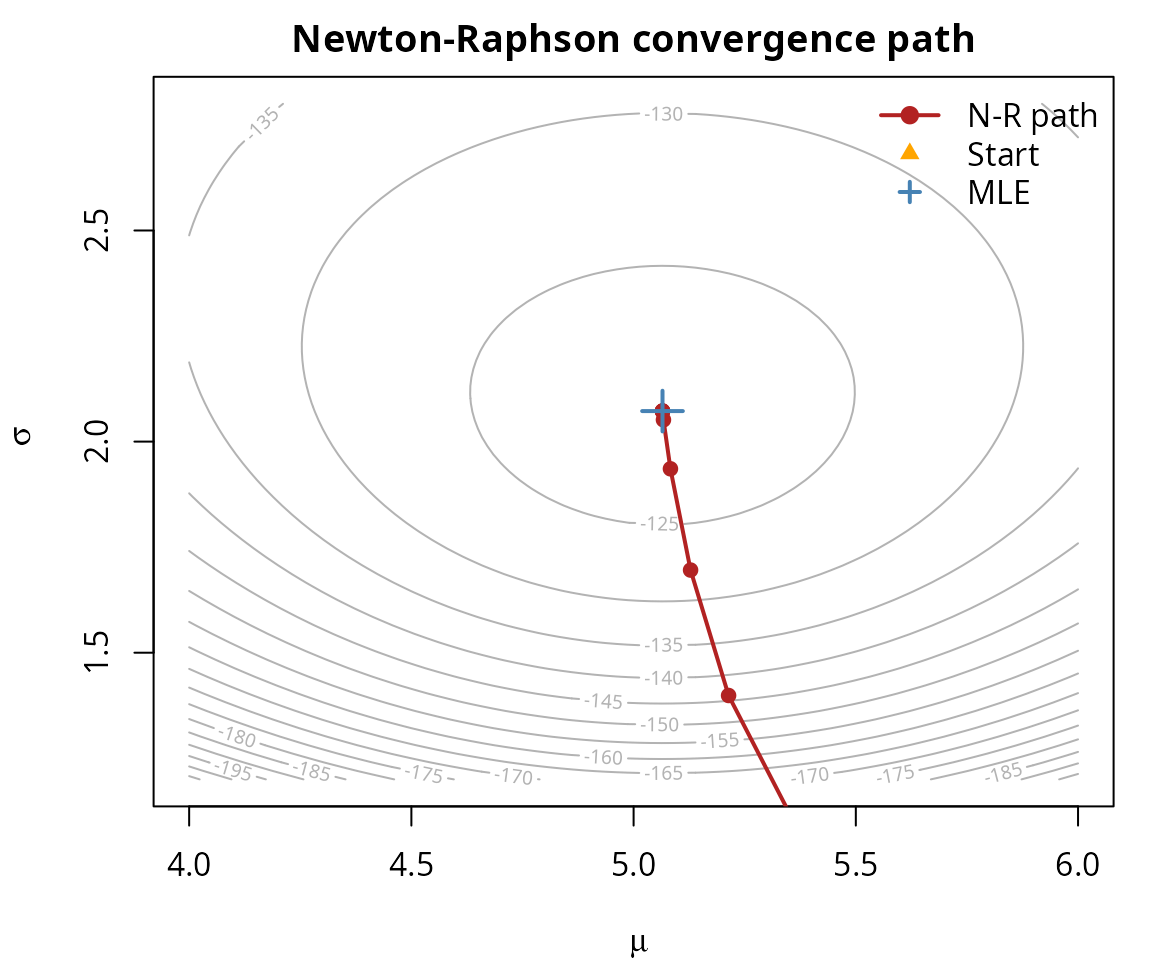
Newton-Raphson converges in 10 iterations — fast quadratic convergence is a hallmark of having exact gradient and Hessian information from AD.
jacobian(): differentiating a vector-valued
function
When a function returns a vector (or list) of outputs,
jacobian() computes the full Jacobian matrix
:
# f: R^2 -> R^3
f_vec <- function(x) {
  a <- x[1]; b <- x[2]
  list(a * b, a^2, sin(b))
}

J <- jacobian(f_vec, c(2, pi/4))
J
#>           [,1]      [,2]
#> [1,] 0.7853982 2.0000000
#> [2,] 4.0000000 0.0000000
#> [3,] 0.0000000 0.7071068

# Analytical Jacobian at (2, pi/4):
# Row 1: d(a*b)/da = b = pi/4,  d(a*b)/db = a = 2
# Row 2: d(a^2)/da = 2a = 4,    d(a^2)/db = 0
# Row 3: d(sin(b))/da = 0,      d(sin(b))/db = cos(b)
This is useful for sensitivity analysis, implicit differentiation, or any application where a function maps multiple inputs to multiple outputs.
Summary
Across five models of increasing complexity, several patterns emerge:
-
AD matches analytical derivatives to machine
precision. Whether the function involves simple polynomials
(Normal), special functions (
lgammain Gamma), or loops over observations (logistic regression),gradient()andhessian()return exact results. - Finite differences introduce step-size-dependent error. For simple models the error is negligible (), but for loop-based functions it grows to — large enough to affect optimization convergence and standard error estimates.
-
jacobian()extends to vector-valued functions. For functions ,jacobian()computes the full Jacobian matrix using forward passes. - Newton-Raphson with AD gradients converges in few iterations. The exact Hessian provides the quadratic convergence that Newton’s method promises in theory — no line search or quasi-Newton approximation needed.