Introduction
The flexhaz package provides a flexible framework for
working with survival distributions defined through their hazard
(failure rate) functions. Instead of choosing from a fixed
catalog of distributions, you directly specify the hazard function
itself, giving complete flexibility to model systems with complex,
time-varying failure patterns.
Why hazard-based parameterization?
Traditional approaches use parametric families (Weibull, exponential, log-normal) that impose strong assumptions on failure rate behavior. The hazard function provides a more intuitive parameterization for reliability:
- Constant hazard: Exponential distribution (memoryless failures)
- Increasing hazard: Wear-out phenomena
- Decreasing hazard: Burn-in or infant mortality
- Bathtub curve: Common in electronics and human mortality
Getting Started
Using Built-in Distributions
The package provides convenient constructors for classic survival distributions:
# Exponential: constant hazard h(t) = lambda
exp_dist <- dfr_exponential(lambda = 0.5)

# Weibull: power-law hazard h(t) = (k/sigma)(t/sigma)^(k-1)
weib_dist <- dfr_weibull(shape = 2, scale = 3)

# Gompertz: exponentially increasing hazard h(t) = a*exp(b*t)
gomp_dist <- dfr_gompertz(a = 0.01, b = 0.1)

# Log-logistic: non-monotonic hazard (increases then decreases)
ll_dist <- dfr_loglogistic(alpha = 10, beta = 2)

print(exp_dist)
#> Dynamic failure rate (DFR) distribution with failure rate:
#> function (t, par, ...)
#> {
#>     rep(par[[1]], length(t))
#> }
#> <bytecode: 0x56152219efb0>
#> <environment: 0x5615221a1840>
#> It has a survival function given by:
#>     S(t|rate) = exp(-H(t,...))
#> where H(t,...) is the cumulative hazard function.
is_dfr_dist(exp_dist)
#> [1] TRUE
Creating Custom Distributions
For non-standard hazard patterns, use dfr_dist()
directly:
# Custom: linear increasing hazard h(t) = a + b*t
linear_dist <- dfr_dist(
  rate = function(t, par, ...) {
    a <- par[1]
    b <- par[2]
    a + b * t
  },
  par = c(a = 0.1, b = 0.01)
)
The rate function must accept:
-
t: time (scalar or vector) -
par: parameter vector -
...: additional arguments
See vignette("custom_distributions") for detailed
guidance on creating optimized custom distributions.
Distribution Methods
All standard distribution functions are available:
Likelihood Model Interface
The dfr_dist class implements the likelihood.model
interface, enabling maximum likelihood estimation with survival
data.
Log-likelihood for survival data
For exact observations (failures at known times):
For right-censored observations (survived past time ):
Creating test data
# Simulate exact failure times from exponential(lambda=1)
set.seed(123)
true_lambda <- 1
n <- 50
times <- rexp(n, rate = true_lambda)

# Create data frame with standard survival format
# delta = 1 means exact observation, delta = 0 means censored
df_exact <- data.frame(t = times, delta = rep(1, n))
head(df_exact)
#>            t delta
#> 1 0.84345726     1
#> 2 0.57661027     1
#> 3 1.32905487     1
#> 4 0.03157736     1
#> 5 0.05621098     1
#> 6 0.31650122     1
Computing log-likelihood
dist <- dfr_dist(
  rate = function(t, par, ...) rep(par[1], length(t)),
  par = NULL  # No default - must be supplied
)

ll <- loglik(dist)

# Evaluate at different parameter values
ll(df_exact, par = c(0.5))  # lambda = 0.5
#> [1] -62.91663
ll(df_exact, par = c(1.0))  # lambda = 1.0 (true value)
#> [1] -56.51854
ll(df_exact, par = c(2.0))  # lambda = 2.0
#> [1] -78.37973
The log-likelihood should be highest near the true parameter value.
Score function (gradient)
The score function is the gradient of the log-likelihood with respect to parameters. It’s computed numerically by default:
Hessian of log-likelihood
H_ll <- hess_loglik(dist)
hess <- H_ll(df_exact, par = c(1.0))
hess  # Should be negative (concave at maximum)
#>      [,1]
#> [1,]  -50
Maximum Likelihood Estimation
The fit() function provides MLE estimation:
solver <- fit(dist)

# Find MLE starting from initial guess
result <- solver(df_exact, par = c(0.5), method = "BFGS")

# Extract fitted parameters (the fisher_mle class from likelihood.model uses coef())
coef(result)
#> [1] 0.8846654

# Compare to analytical MLE: lambda_hat = n / sum(t)
analytical_mle <- n / sum(times)
c(fitted = coef(result), analytical = analytical_mle, true = true_lambda)
#>     fitted analytical       true
#>  0.8846654  0.8846654  1.0000000
Working with censored data
Real survival data often includes censoring. Here’s an example with mixed data:
# Some observations are censored (patient still alive at study end)
df_mixed <- data.frame(
  t = c(1, 2, 3, 4, 5, 6, 7, 8),
  delta = c(1, 1, 1, 0, 0, 1, 1, 0)  # 0 = censored
)

ll <- loglik(dist)

# Fit with censored data
solver <- fit(dist)
result <- solver(df_mixed, par = c(0.5), method = "BFGS")
coef(result)
#> [1] 0.1388889
Example: Weibull MLE
# Create Weibull DFR
weibull <- dfr_dist(
  rate = function(t, par, ...) {
    k <- par[1]
    sigma <- par[2]
    (k / sigma) * (t / sigma)^(k - 1)
  }
)

# Simulate Weibull data (shape=2, scale=3)
set.seed(456)
true_shape <- 2
true_scale <- 3
n <- 100

# Use inverse CDF sampling
u <- runif(n)
weibull_times <- true_scale * (-log(u))^(1/true_shape)

df_weibull <- data.frame(t = weibull_times, delta = rep(1, n))

# Fit
solver <- fit(weibull)
result <- solver(df_weibull, par = c(1.5, 2.5), method = "BFGS")

c(fitted_shape = coef(result)[1], true_shape = true_shape)
#> fitted_shape   true_shape
#>      1.92518      2.00000
c(fitted_scale = coef(result)[2], true_scale = true_scale)
#> fitted_scale   true_scale
#>     2.788113     3.000000
Custom Hazard Functions
The real power of flexhaz is modeling complex,
non-standard hazard patterns.
Bathtub hazard
A classic bathtub curve has three phases: 1. Infant mortality: High initial failure rate that decreases 2. Useful life: Low, relatively constant failure rate 3. Wear-out: Increasing failure rate as components age
# h(t) = a * exp(-b*t) + c + d * t^k
# Three components: infant mortality + baseline + wear-out
bathtub <- dfr_dist(
  rate = function(t, par, ...) {
    a <- par[1]  # infant mortality magnitude
    b <- par[2]  # infant mortality decay rate
    c <- par[3]  # baseline hazard (useful life)
    d <- par[4]  # wear-out coefficient
    k <- par[5]  # wear-out exponent
    a * exp(-b * t) + c + d * t^k
  },
  par = c(a = 1, b = 2, c = 0.02, d = 0.001, k = 2)
)

# Plot the hazard function
t_seq <- seq(0.01, 15, length.out = 200)
h <- hazard(bathtub)
plot(t_seq, sapply(t_seq, h), type = "l",
     xlab = "Time", ylab = "Hazard rate",
     main = "Bathtub hazard curve")
Time-covariate interaction
Hazards can depend on covariates that modify the time effect:
# Proportional hazards with covariate x
# h(t, x) = h0(t) * exp(beta * x)
# where h0(t) = Weibull baseline

ph_model <- dfr_dist(
  rate = function(t, par, x = 0, ...) {
    k <- par[1]
    sigma <- par[2]
    beta <- par[3]
    baseline <- (k / sigma) * (t / sigma)^(k - 1)
    baseline * exp(beta * x)
  },
  par = c(shape = 2, scale = 3, beta = 0.5)
)

h <- hazard(ph_model)

# Hazard for different covariate values
h(2, x = 0)  # Baseline
#>     shape
#> 0.4444444
h(2, x = 1)  # Higher risk group
#>    shape
#> 0.732765
Integration with algebraic.dist
The dfr_dist class inherits from algebraic.dist
classes, providing access to additional functionality:
Model Diagnostics
After fitting a model, it’s essential to verify goodness-of-fit. The package provides diagnostic tools based on residual analysis.
Cox-Snell Residuals
Cox-Snell residuals are defined as r_i = H(t_i), the cumulative hazard at each observation time. If the model is correctly specified, these residuals follow an Exp(1) distribution.
# Fit a model and check residuals
set.seed(99)
test_times <- rexp(80, rate = 0.3)
test_df <- data.frame(t = test_times, delta = 1)

# Fit exponential
exp_fitted <- dfr_exponential()
solver <- fit(exp_fitted)
fit_result <- solver(test_df, par = c(0.5))
lambda_hat <- coef(fit_result)

# Create fitted distribution with estimated parameters
exp_final <- dfr_exponential(lambda = lambda_hat)

# Q-Q plot of Cox-Snell residuals
qqplot_residuals(exp_final, test_df)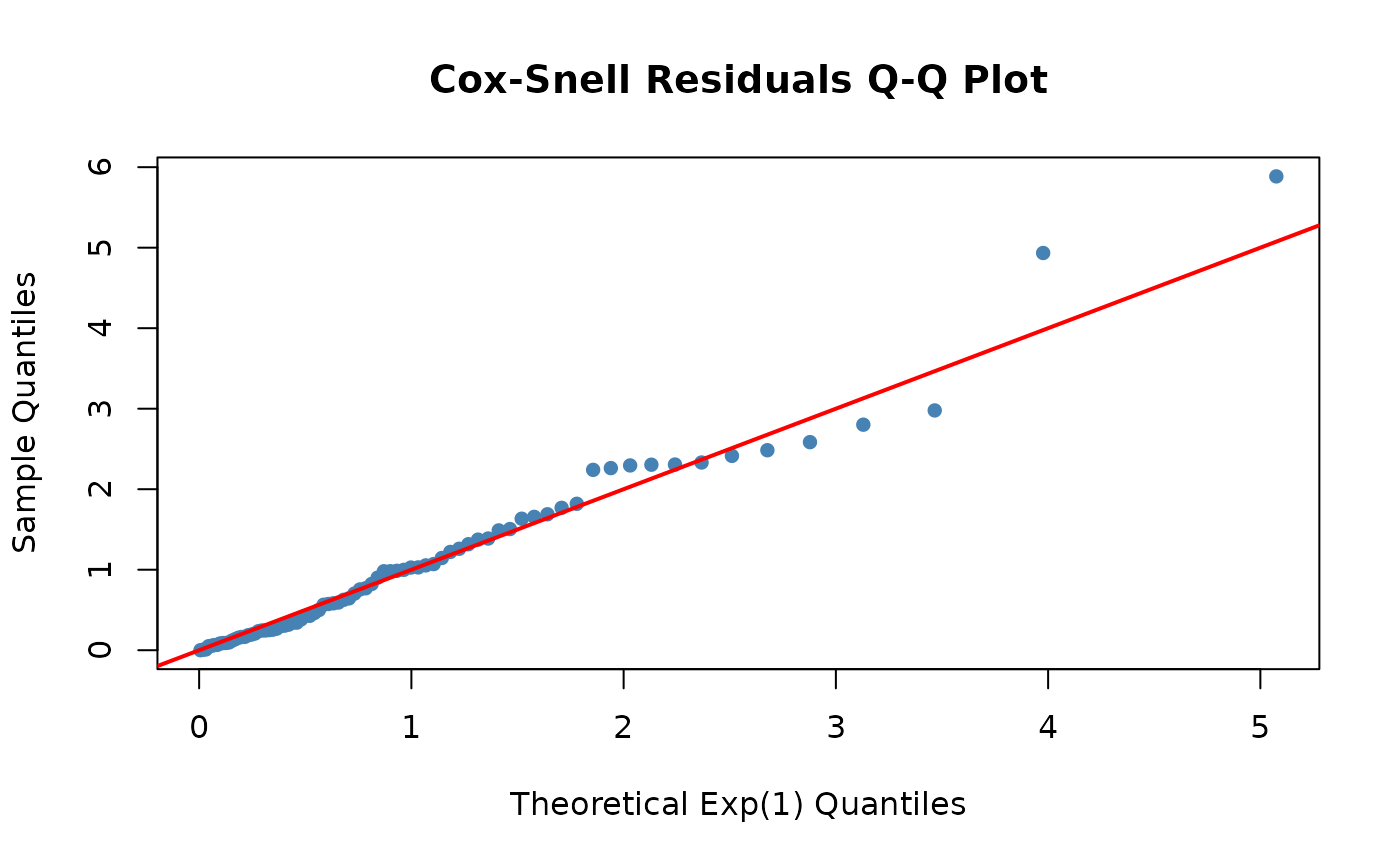
Points falling along the diagonal indicate good fit. Systematic departures suggest model misspecification.
Martingale Residuals
Martingale residuals (M_i = delta_i - H(t_i)) are useful for identifying individual observations that are poorly fit:
mart_resid <- residuals(exp_final, test_df, type = "martingale")
summary(mart_resid)
#>    Min. 1st Qu.  Median    Mean 3rd Qu.    Max.
#> -4.8856 -0.4127  0.3650  0.0000  0.7569  0.9998

# Large positive values: failed earlier than expected
# Large negative values: survived longer than expected
For more detailed diagnostic workflows, see
vignette("reliability_engineering").
Summary
The flexhaz package provides:
- Flexible specification: Define distributions through hazard functions
- Complete distribution interface: hazard, survival, CDF, PDF, quantiles, sampling
- Likelihood model support: Log-likelihood, score, Hessian for MLE
- Censoring support: Handle exact, right-censored, and left-censored survival data
- Numerical integration: Automatic computation of cumulative hazard
- Model diagnostics: Residuals and Q-Q plots for fit assessment
This makes it ideal for:
- Custom reliability models
- Survival analysis with non-standard hazard patterns
- Maximum likelihood estimation of hazard function parameters
- Simulation studies with flexible failure distributions
Next Steps
-
vignette("flexhaz-package")- Package introduction and quick start -
vignette("reliability_engineering")- Five real-world case studies -
vignette("custom_distributions")- The three-level optimization paradigm -
vignette("custom_derivatives")- Supplying analytical score and Hessian functions