Theory and Intuition Behind Numerical MLE
Alexander Towell
2025-12-02
Source:vignettes/theory-and-intuition.Rmd
theory-and-intuition.RmdWhat is Maximum Likelihood Estimation?
Maximum Likelihood Estimation (MLE) is a fundamental method for estimating the parameters of a statistical model. The idea is simple yet powerful: find the parameter values that make the observed data most probable.
The Likelihood Function
Suppose we observe data and we believe it comes from a probability distribution with parameter(s) . The likelihood function measures how probable the observed data is, given parameter :
For independent observations:
where is the probability density (or mass) function.
Why Log-Likelihood?
Working with products is numerically unstable and mathematically inconvenient. Taking the logarithm converts products to sums:
Since is monotonic, maximizing is equivalent to maximizing . The log-likelihood has several advantages:
- Numerical stability: Products of small probabilities can underflow to zero
- Computational efficiency: Sums are faster than products
- Mathematical convenience: Derivatives of sums are easier than derivatives of products
- Statistical properties: The curvature of relates to estimation uncertainty
A Concrete Example
Let’s see this with normal data:
set.seed(42)
x <- rnorm(50, mean = 3, sd = 1.5)

# Log-likelihood function for normal distribution
loglike <- function(theta) {
  mu <- theta[1]
  sigma <- theta[2]
  if (sigma <= 0) return(-Inf)
  sum(dnorm(x, mean = mu, sd = sigma, log = TRUE))
}

# Visualize the log-likelihood surface
mu_grid <- seq(1, 5, length.out = 50)
sigma_grid <- seq(0.5, 3, length.out = 50)
ll_surface <- outer(mu_grid, sigma_grid, function(m, s) {
  mapply(function(mi, si) loglike(c(mi, si)), m, s)
})

# Contour plot
contour(mu_grid, sigma_grid, ll_surface, nlevels = 20,
        xlab = expression(mu), ylab = expression(sigma),
        main = "Log-Likelihood Surface")
points(mean(x), sd(x), pch = 19, col = "red", cex = 1.5)
legend("topright", "MLE", pch = 19, col = "red")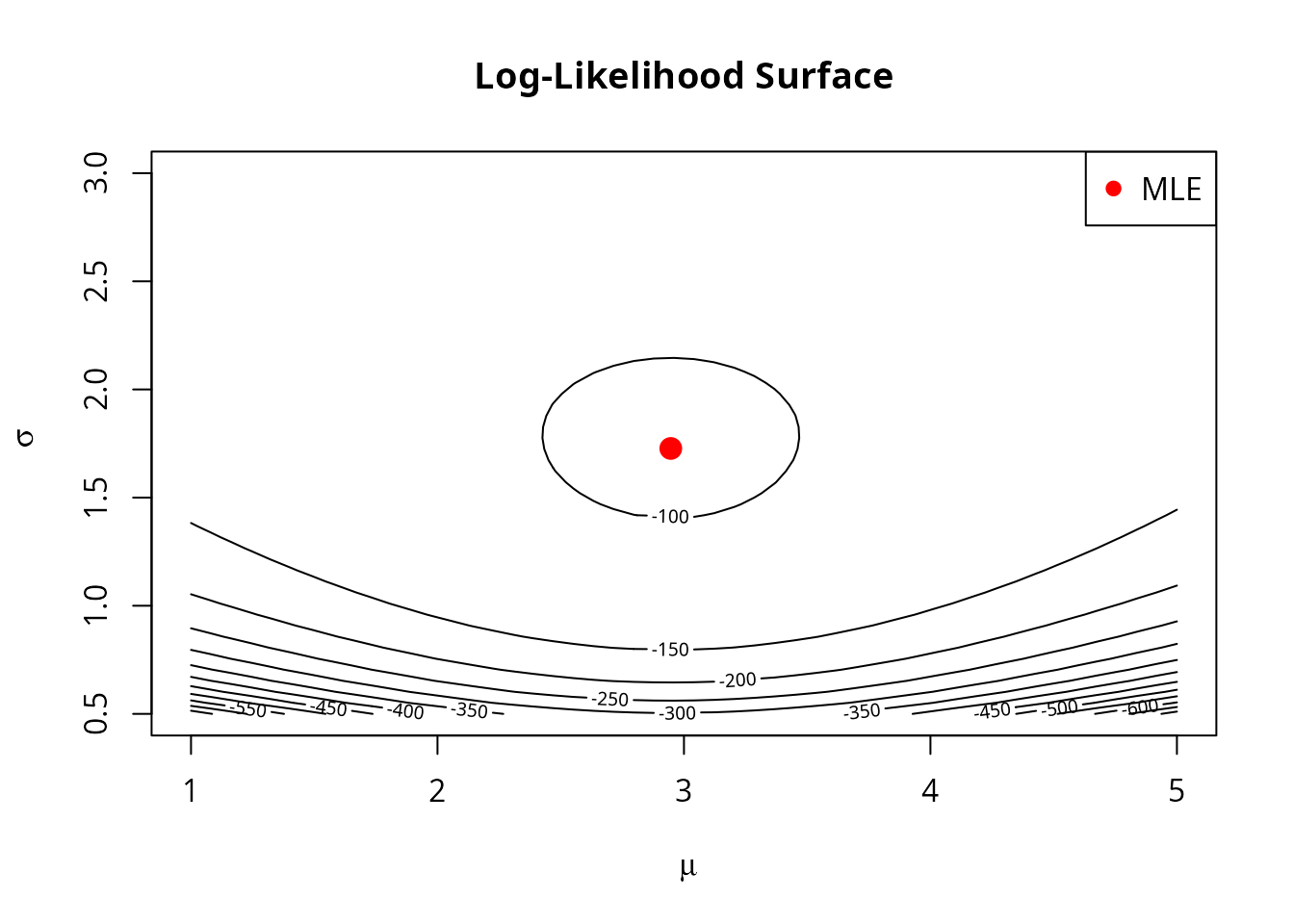
The MLE is the point on this surface with the highest value (deepest red in the contour plot).
The Score Function
The score function is the gradient (vector of partial derivatives) of the log-likelihood:
At the MLE , the score is zero: .
Intuition
The score tells us the direction of steepest ascent on the log-likelihood surface. If , we can increase the likelihood by moving in the direction of .
# Score function for normal distribution
score <- function(theta) {
  mu <- theta[1]
  sigma <- theta[2]
  n <- length(x)
  c(
    sum(x - mu) / sigma^2,                        # d/d_mu
    -n / sigma + sum((x - mu)^2) / sigma^3        # d/d_sigma
  )
}

# At a point away from the MLE, the score points toward the MLE
theta_start <- c(1, 0.8)
s <- score(theta_start)
cat("Score at (1, 0.8):", round(s, 2), "\n")
#> Score at (1, 0.8): 152.07 593.01
cat("Direction: move", ifelse(s[1] > 0, "right", "left"), "in mu,",
    ifelse(s[2] > 0, "up", "down"), "in sigma\n")
#> Direction: move right in mu, up in sigma
Gradient Ascent
Gradient ascent is the simplest optimization algorithm. It iteratively moves in the direction of the gradient:
where is the learning rate (step size).
Why It Works
The score points in the direction of steepest increase. Taking small steps in this direction guarantees improvement (for small enough ).
The Challenge: Choosing the Step Size
- Too large: We might overshoot and oscillate
- Too small: Convergence is painfully slow
# Demonstrate gradient ascent with different step sizes
run_gradient_ascent <- function(eta, max_iter = 50) {
  theta <- c(1, 0.8)
  path <- matrix(NA, max_iter + 1, 2)
  path[1, ] <- theta

  for (i in 1:max_iter) {
    theta <- theta + eta * score(theta)
    if (theta[2] <= 0) theta[2] <- 0.01  # Enforce constraint
    path[i + 1, ] <- theta
  }
  path
}

# Compare step sizes
path_small <- run_gradient_ascent(0.001)
path_good <- run_gradient_ascent(0.01)
path_large <- run_gradient_ascent(0.05)

# Plot paths
contour(mu_grid, sigma_grid, ll_surface, nlevels = 15,
        xlab = expression(mu), ylab = expression(sigma),
        main = "Gradient Ascent: Effect of Step Size")
lines(path_small[, 1], path_small[, 2], col = "blue", lwd = 2)
lines(path_good[, 1], path_good[, 2], col = "green", lwd = 2)
lines(path_large[1:20, 1], path_large[1:20, 2], col = "red", lwd = 2)
points(mean(x), sd(x), pch = 19, cex = 1.5)
legend("topright", c("Small (0.001)", "Good (0.01)", "Large (0.05)"),
       col = c("blue", "green", "red"), lwd = 2)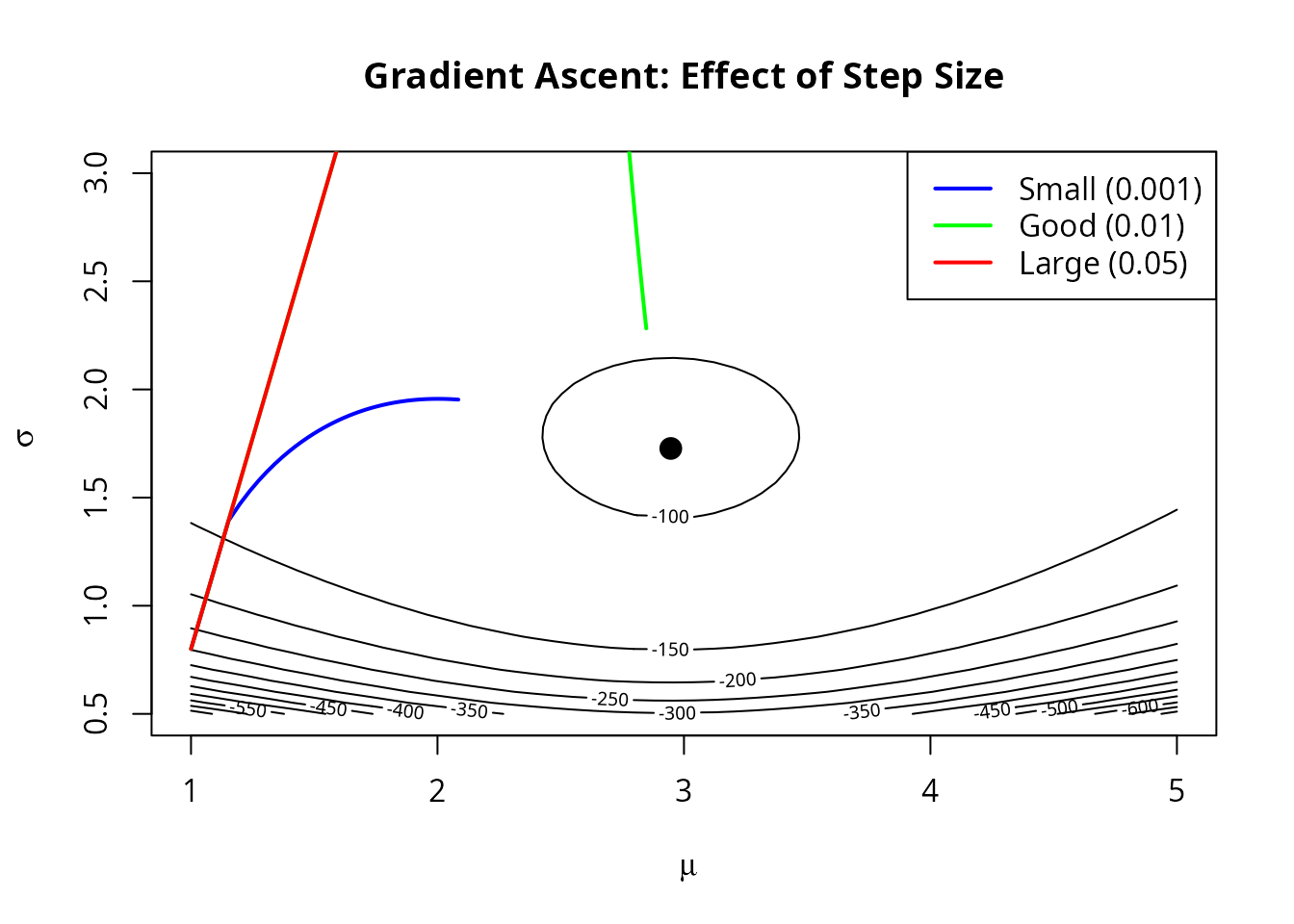
Line Search: Automatic Step Size Selection
Backtracking line search adaptively finds a good step size:
- Start with a large step size
- If it doesn’t improve the objective enough, shrink it
- Repeat until we find an acceptable step
This is implemented in mle_config_linesearch():
result <- mle_gradient_ascent(
  loglike = loglike,
  score = score,
  theta0 = c(1, 0.8),
  config = mle_config_linesearch(max_iter = 50, trace = TRUE),
  constraint = mle_constraint(
    support = function(theta) theta[2] > 0,
    project = function(theta) c(theta[1], max(theta[2], 1e-6))
  )
)

cat("Final estimate:", round(result$theta.hat, 4), "\n")
#> Final estimate: 2.9472 1.7103
cat("Iterations:", result$iter, "\n")
#> Iterations: 8
cat("Converged:", result$converged, "\n")
#> Converged: FALSE
The Fisher Information Matrix
The Fisher information matrix measures how much information the data carries about :
It’s also related to the variance of the score: .
Newton-Raphson
Newton-Raphson uses the Fisher information to take smarter steps:
Intuition
Gradient ascent treats all directions equally, but some directions might be “easier” to move in than others. Newton-Raphson pre-multiplies by , which:
- Takes larger steps in flat directions (low curvature)
- Takes smaller steps in curved directions (high curvature)
- Accounts for correlations between parameters
Comparison
# Fisher information for normal distribution
fisher <- function(theta) {
  sigma <- theta[2]
  n <- length(x)
  matrix(c(
    n / sigma^2, 0,
    0, 2 * n / sigma^2
  ), nrow = 2)
}

# Run gradient ascent
result_ga <- mle_gradient_ascent(
  loglike = loglike,
  score = score,
  theta0 = c(1, 0.8),
  config = mle_config_linesearch(max_iter = 100, trace = TRUE),
  constraint = mle_constraint(
    support = function(theta) theta[2] > 0,
    project = function(theta) c(theta[1], max(theta[2], 1e-6))
  )
)

# Run Newton-Raphson
result_nr <- mle_newton_raphson(
  loglike = loglike,
  score = score,
  fisher = fisher,
  theta0 = c(1, 0.8),
  config = mle_config_linesearch(max_iter = 100, trace = TRUE),
  constraint = mle_constraint(
    support = function(theta) theta[2] > 0,
    project = function(theta) c(theta[1], max(theta[2], 1e-6))
  )
)

cat("Gradient Ascent: ", result_ga$iter, "iterations\n")
#> Gradient Ascent:  8 iterations
cat("Newton-Raphson:  ", result_nr$iter, "iterations\n")
#> Newton-Raphson:   11 iterations
Newton-Raphson typically converges much faster, especially near the optimum where its quadratic convergence kicks in.
When to Use Which Method
Use Gradient Ascent When:
- You don’t have (or can’t easily compute) the Fisher information
- The problem is high-dimensional (computing is expensive)
- You’re using stochastic gradients (mini-batches)
- Getting a rough answer quickly is acceptable
Use Newton-Raphson When:
- You need high precision
- The Fisher information is available and cheap to compute
- The problem is low-to-moderate dimensional
- Fast convergence is important
Constrained Optimization
Real problems often have constraints on parameters:
- Variance must be positive:
- Probabilities must be in
- Correlation must satisfy
Projection Method
The numerical.mle package uses
projection: if a step takes us outside the feasible
region, we project back to the nearest feasible point.
# Without constraint: optimization might fail
constraint <- mle_constraint(
  support = function(theta) theta[2] > 0,
  project = function(theta) c(theta[1], max(theta[2], 1e-6))
)

# The constraint keeps sigma positive throughout optimization
result <- mle_gradient_ascent(
  loglike = loglike,
  score = score,
  theta0 = c(0, 0.1),  # Start near the boundary
  config = mle_config_linesearch(max_iter = 100),
  constraint = constraint
)

cat("Final sigma:", result$theta.hat[2], "> 0 (constraint satisfied)\n")
#> Final sigma: 1.710644 > 0 (constraint satisfied)
Regularization and Penalized Likelihood
Sometimes we want to penalize certain parameter values to:
- Prevent overfitting
- Encourage sparsity
- Incorporate prior beliefs
Common Penalties
L1 (LASSO):
- Encourages sparsity (some )
- Useful for variable selection
L2 (Ridge):
- Shrinks parameters toward zero
- Prevents extreme values
- Equivalent to Gaussian prior
Elastic Net:
- Combines L1 and L2 benefits
- controls the mix
# Original log-likelihood (maximum at theta = 0)
loglike <- function(theta) -sum((theta - c(3, 2))^2)

# Add L2 penalty
loglike_l2 <- with_penalty(loglike, penalty_l2(), lambda = 1)

# Compare
theta <- c(3, 2)
cat("At theta = (3, 2):\n")
#> At theta = (3, 2):
cat("  Original:", loglike(theta), "\n")
#>   Original: 0
cat("  With L2 penalty:", loglike_l2(theta), "\n")
#>   With L2 penalty: -13
cat("  The penalty shrinks the solution toward zero\n")
#>   The penalty shrinks the solution toward zero
Stochastic Gradient Methods
For large datasets, computing the full gradient is expensive. Stochastic gradient ascent uses random subsamples:
where is computed on a mini-batch of data.
Properties
- Noisy but unbiased: On average, we move in the right direction
- Faster iterations: Each step is cheap
- Implicit regularization: Noise can help escape local optima
- Requires care: Learning rate schedules, momentum, etc.
# Concept demonstration (not run)
loglike_full <- function(theta, obs = large_data) {
  sum(dnorm(obs, theta[1], theta[2], log = TRUE))
}

# Use only 100 observations per iteration
loglike_mini <- with_subsampling(
  loglike_full,
  data = large_data,
  subsample_size = 100
)
Convergence Criteria
The package checks for convergence using:
- Absolute tolerance:
- Relative tolerance:
- Parameter change:
- Maximum iterations: Safety stop
config <- mle_config(
  max_iter = 500,     # Don't run forever
  abs_tol = 1e-8,     # Absolute change threshold
  rel_tol = 1e-6,     # Relative change threshold
  debug = FALSE       # Set TRUE to see iteration progress
)
Summary
| Method | Order | Information Needed | Best For |
|---|---|---|---|
| Gradient Ascent | 1st | Score only | Large problems, rough estimates |
| Newton-Raphson | 2nd | Score + Fisher | High precision, small problems |
| Grid Search | 0th | Likelihood only | Finding starting points |
| Random Restart | - | Varies | Multi-modal problems |
The numerical.mle package provides a unified interface
to all these methods, with composable configuration objects and function
transformers to handle real-world complexities like constraints,
regularization, and large datasets.