Censoring Types in Series System Masked Data
Source:vignettes/censoring_comparison.Rmd
censoring_comparison.RmdThis vignette compares the four observation types supported by the
maskedcauses package across all three likelihood models:
exponential, homogeneous Weibull, and heterogeneous Weibull. We study
how the choice of monitoring scheme—and hence the mix of censoring
types—affects the information content of the data and the quality of
maximum likelihood estimates.
Overview of Observation Types
When monitoring a series system, the observation mechanism determines what we learn about the system failure time . The package supports four observation types, each arising from a different monitoring design.
Exact (). The system failure time is observed directly. This occurs under continuous monitoring when the system fails during the study period. The log-likelihood contribution is where is the system survival function and is the candidate-set hazard.
Right-censored (). The system is known to have survived past time , but the actual failure time is unknown. This arises when the study ends before the system fails. The contribution is Note that right-censored observations carry no candidate set information.
Left-censored (). The system is known to have failed before inspection time , but we do not know when. This occurs in a single-inspection design: if the system is found failed at inspection, the failure time is left-censored at . The contribution is where is the candidate cause weight and .
Interval-censored (). The failure occurred in a known interval . This arises from periodic inspections: the system was functioning at time and found failed at time . The contribution is
Information ordering. Intuitively, exact observations are the most informative since they pin down precisely. Right-censored observations provide only a lower bound. Left-censored observations provide only an upper bound. Interval-censored observations bracket from both sides, typically making them more informative than one-sided censoring: The relative ranking of left versus right depends on the hazard structure; for exponential models they are roughly symmetric.
Data Generation with Observe Functors
The package provides composable observe functors that
translate a true system failure time into an observed record. Each
functor returns a list with elements t (observed time),
omega (observation type), and t_upper (upper
bound, for interval-censoring only).
# 1. Right-censoring: continuous monitoring, study ends at tau
obs_right <- observe_right_censor(tau = 10)
obs_right(7)   # failure before tau -> exact
#> $t
#> [1] 7
#>
#> $omega
#> [1] "exact"
#>
#> $t_upper
#> [1] NA
obs_right(15)  # survival past tau  -> right-censored
#> $t
#> [1] 10
#>
#> $omega
#> [1] "right"
#>
#> $t_upper
#> [1] NA

# 2. Left-censoring: single inspection at tau
obs_left <- observe_left_censor(tau = 10)
obs_left(7)    # failed before inspection -> left-censored
#> $t
#> [1] 10
#>
#> $omega
#> [1] "left"
#>
#> $t_upper
#> [1] NA
obs_left(15)   # surviving at inspection  -> right-censored
#> $t
#> [1] 10
#>
#> $omega
#> [1] "right"
#>
#> $t_upper
#> [1] NA

# 3. Periodic inspection: inspections every delta, study ends at tau
obs_periodic <- observe_periodic(delta = 2, tau = 10)
obs_periodic(5.3)  # failure in (4, 6) -> interval-censored
#> $t
#> [1] 4
#>
#> $omega
#> [1] "interval"
#>
#> $t_upper
#> [1] 6
obs_periodic(15)   # survival past tau -> right-censored
#> $t
#> [1] 10
#>
#> $omega
#> [1] "right"
#>
#> $t_upper
#> [1] NA

# 4. Mixture: compose arbitrary monitoring schemes
obs_mixed <- observe_mixture(
  observe_right_censor(tau = 10),
  observe_left_censor(tau = 5),
  observe_periodic(delta = 2, tau = 10),
  weights = c(0.5, 0.2, 0.3)
)
The observe_mixture functor is the key to building
realistic monitoring scenarios. For each observation, it randomly
selects one of the constituent schemes according to the supplied
weights. This models heterogeneous monitoring environments where
different units are observed differently—some under continuous
monitoring, others inspected periodically.
All rdata() methods accept an observe
argument:
model <- exp_series_md_c1_c2_c3()
gen <- rdata(model)
theta <- c(1, 1.1, 0.95)

set.seed(42)
df <- gen(theta, n = 200, p = 0.3,
          observe = observe_periodic(delta = 0.5, tau = 5))
cat("Observation type distribution:\n")
#> Observation type distribution:
print(table(df$omega))
#>
#> interval
#>      200
Exponential Model: Closed-Form Verification
The exponential model is special: all four observation types have fully analytical log-likelihood, score, and Hessian. We verify this on a small mixed-censoring example with one observation of each type.
# Construct one observation of each type
df_mixed <- data.frame(
  t       = c(3.0,  8.0,  5.0,  2.0),
  t_upper = c(NA,   NA,   NA,   6.0),
  omega   = c("exact", "right", "left", "interval"),
  x1      = c(TRUE,  FALSE, TRUE,  TRUE),
  x2      = c(TRUE,  FALSE, FALSE, TRUE),
  x3      = c(FALSE, FALSE, TRUE,  FALSE),
  stringsAsFactors = FALSE
)
rates <- c(0.5, 0.3, 0.2)
lambda_sys <- sum(rates)
For the exponential model with rates and , the individual contributions are:
exp_model <- exp_series_md_c1_c2_c3()
ll_fn <- loglik(exp_model)
scr_fn <- score(exp_model)

# Total log-likelihood
ll_val <- ll_fn(df_mixed, rates)
cat("Log-likelihood:", round(ll_val, 6), "\n")
#> Log-likelihood: -13.83

# Expected from hand calculation
ll_exact    <- log(0.8) - lambda_sys * 3
ll_right    <- -lambda_sys * 8
ll_left     <- log(0.7) + log(-expm1(-lambda_sys * 5)) - log(lambda_sys)
ll_interval <- log(0.8) - lambda_sys * 2 +
  log(-expm1(-lambda_sys * 4)) - log(lambda_sys)
ll_expected <- ll_exact + ll_right + ll_left + ll_interval
cat("Expected:      ", round(ll_expected, 6), "\n")
#> Expected:       -13.83
cat("Match:", all.equal(ll_val, ll_expected, tolerance = 1e-10), "\n")
#> Match: TRUE
Now verify that the analytical score is consistent with numerical differentiation:
scr_analytical <- scr_fn(df_mixed, rates)
scr_numerical <- numDeriv::grad(
  func = function(th) ll_fn(df_mixed, th),
  x = rates
)

score_df <- data.frame(
  Component = paste0("lambda_", 1:3),
  Analytical = round(scr_analytical, 6),
  Numerical = round(scr_numerical, 6),
  Abs_Diff = formatC(abs(scr_analytical - scr_numerical),
                     format = "e", digits = 2)
)
knitr::kable(score_df, caption = "Score verification: analytical vs numerical")| Component | Analytical | Numerical | Abs_Diff |
|---|---|---|---|
| lambda_1 | -10.96 | -10.96 | 3.46e-10 |
| lambda_2 | -12.39 | -12.39 | 3.85e-10 |
| lambda_3 | -13.46 | -13.46 | 2.20e-09 |
The agreement to machine precision confirms that all four observation types are implemented correctly in the exponential score.
Simulation: Information Content by Censoring Mix
We now study how the mix of censoring types affects estimation quality. Using the exponential model with components, we generate data under five monitoring configurations and compare bias, MSE, and coverage.
The five configurations are:
| Config | Description | Observe Functor |
|---|---|---|
| A | 100% exact | observe_right_censor(tau = Inf) |
| B | 75% exact + 25% right |
observe_right_censor(tau) with
set for 25% censoring |
| C | ~75% left + ~25% right |
observe_left_censor(tau) — failed before
are left-censored, survivors right-censored |
| D | 75% exact + 12.5% left + 12.5% interval | observe_mixture(...) |
| E | 50% exact + 20% right + 15% left + 15% interval | observe_mixture(...) |
set.seed(7231)
theta <- c(1.0, 1.1, 0.95)
m <- length(theta)
n <- 500
B <- 200
alpha <- 0.05

exp_model <- exp_series_md_c1_c2_c3()
gen <- rdata(exp_model)
solver <- fit(exp_model)
theta0 <- rep(1, m)

# tau for ~25% right-censoring: solve S(tau) = 0.25
lambda_sys <- sum(theta)
tau_25 <- -log(0.25) / lambda_sys

# tau for left-censoring: F(tau) ~ 0.75 -> same tau
# For left_censor(tau), Pr(left) = F(tau), Pr(right) = S(tau)

configs <- list(
  A = list(
    name = "100% exact",
    observe = observe_right_censor(tau = Inf)
  ),
  B = list(
    name = "75% exact + 25% right",
    observe = observe_right_censor(tau = tau_25)
  ),
  C = list(
    name = "~75% left + ~25% right",
    observe = observe_left_censor(tau = tau_25)
  ),
  D = list(
    name = "mix: exact + left + interval",
    observe = observe_mixture(
      observe_right_censor(tau = Inf),
      observe_left_censor(tau = tau_25),
      observe_periodic(delta = 0.3, tau = tau_25),
      weights = c(0.75, 0.125, 0.125)
    )
  ),
  E = list(
    name = "mix: all four types",
    observe = observe_mixture(
      observe_right_censor(tau = tau_25),
      observe_left_censor(tau = tau_25),
      observe_periodic(delta = 0.3, tau = tau_25),
      weights = c(0.70, 0.15, 0.15)
    )
  )
)
sim_results <- list()

for (cfg_name in names(configs)) {
  cfg <- configs[[cfg_name]]
  estimates <- matrix(NA, nrow = B, ncol = m)
  se_estimates <- matrix(NA, nrow = B, ncol = m)
  ci_lower <- matrix(NA, nrow = B, ncol = m)
  ci_upper <- matrix(NA, nrow = B, ncol = m)
  converged <- logical(B)
  omega_counts <- list()

  for (b in 1:B) {
    df_b <- gen(theta, n = n, p = 0.3, observe = cfg$observe)

    if (b == 1) {
      omega_counts[[cfg_name]] <- table(df_b$omega)
    }

    tryCatch({
      result_b <- solver(df_b, par = theta0, method = "Nelder-Mead")
      estimates[b, ] <- result_b$par
      se_estimates[b, ] <- sqrt(diag(result_b$vcov))
      z <- qnorm(1 - alpha / 2)
      ci_lower[b, ] <- result_b$par - z * se_estimates[b, ]
      ci_upper[b, ] <- result_b$par + z * se_estimates[b, ]
      converged[b] <- result_b$converged
    }, error = function(e) {
      converged[b] <<- FALSE
    })
  }

  valid <- converged & !is.na(estimates[, 1])
  est_valid <- estimates[valid, , drop = FALSE]

  bias <- colMeans(est_valid) - theta
  variance <- apply(est_valid, 2, var)
  mse <- bias^2 + variance

  coverage <- numeric(m)
  for (j in 1:m) {
    valid_j <- valid & !is.na(ci_lower[, j])
    covered <- ci_lower[valid_j, j] <= theta[j] &
      theta[j] <= ci_upper[valid_j, j]
    coverage[j] <- mean(covered)
  }

  sim_results[[cfg_name]] <- list(
    name = cfg$name,
    bias = bias,
    variance = variance,
    mse = mse,
    coverage = coverage,
    mean_mse = mean(mse),
    mean_coverage = mean(coverage),
    convergence_rate = mean(converged),
    omega_sample = if (length(omega_counts) > 0) omega_counts[[cfg_name]] else NULL
  )
}
Results Table
summary_df <- data.frame(
  Config = names(sim_results),
  Description = sapply(sim_results, function(x) x$name),
  Mean_Bias = sapply(sim_results, function(x) mean(abs(x$bias))),
  Mean_MSE = sapply(sim_results, function(x) x$mean_mse),
  Mean_RMSE = sapply(sim_results, function(x) sqrt(x$mean_mse)),
  Mean_Coverage = sapply(sim_results, function(x) x$mean_coverage),
  Conv_Rate = sapply(sim_results, function(x) x$convergence_rate),
  stringsAsFactors = FALSE, row.names = NULL
)

knitr::kable(summary_df, digits = 4,
             caption = "Estimation quality by monitoring configuration",
             col.names = c("Config", "Description", "Mean |Bias|",
"Mean MSE", "Mean RMSE", "Coverage", "Conv. Rate"))| Config | Description | Mean |Bias| | Mean MSE | Mean RMSE | Coverage | Conv. Rate |
|---|---|---|---|---|---|---|
| A | 100% exact | 0.0077 | 0.0091 | 0.0953 | 0.9450 | 1 |
| B | 75% exact + 25% right | 0.0100 | 0.0129 | 0.1137 | 0.9517 | 1 |
| C | ~75% left + ~25% right | 0.0061 | 0.0122 | 0.1106 | 0.9517 | 1 |
| D | mix: exact + left + interval | 0.0057 | 0.0100 | 0.1002 | 0.9467 | 1 |
| E | mix: all four types | 0.0074 | 0.0118 | 0.1087 | 0.9400 | 1 |
Visualization
cfg_labels <- sapply(sim_results, function(x) x$name)
mse_vals <- sapply(sim_results, function(x) x$mean_mse)
cov_vals <- sapply(sim_results, function(x) x$mean_coverage)

par(mfrow = c(1, 2), mar = c(7, 4, 3, 1))

# MSE comparison
bp <- barplot(mse_vals, names.arg = names(sim_results),
              col = c("steelblue", "coral", "goldenrod", "mediumpurple", "seagreen"),
              main = "Mean MSE by Configuration",
              ylab = "Mean MSE", las = 1)
text(bp, mse_vals + max(mse_vals) * 0.03,
     labels = round(mse_vals, 4), cex = 0.8)

# Coverage comparison
barplot(cov_vals, names.arg = names(sim_results),
        col = c("steelblue", "coral", "goldenrod", "mediumpurple", "seagreen"),
        main = "Mean Coverage by Configuration",
        ylab = "Coverage Probability", las = 1,
        ylim = c(0.85, 1.0))
abline(h = 1 - alpha, lty = 2, col = "red", lwd = 2)
text(x = bp, y = 0.86, labels = round(cov_vals, 3), cex = 0.8)
legend("bottomright", legend = "Nominal 95%", lty = 2, col = "red",
       lwd = 2, cex = 0.8)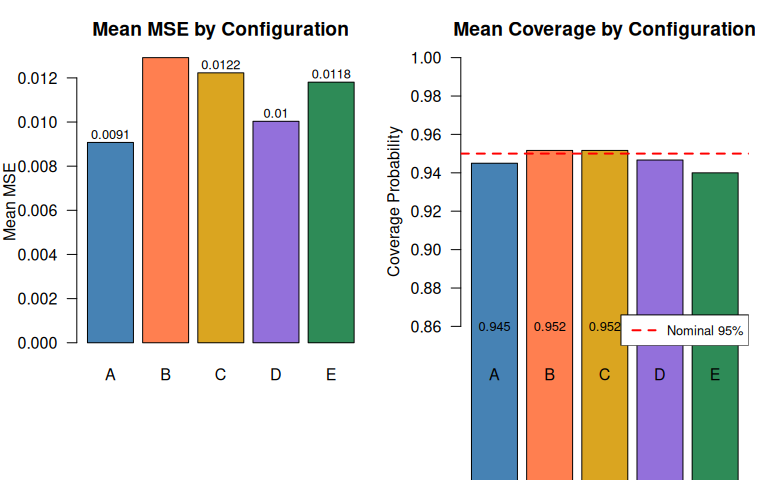
Per-Component Detail
comp_rows <- list()
for (cfg_name in names(sim_results)) {
  res <- sim_results[[cfg_name]]
  for (j in 1:m) {
    comp_rows[[length(comp_rows) + 1]] <- data.frame(
      Config = cfg_name,
      Component = j,
      True = theta[j],
      Bias = res$bias[j],
      MSE = res$mse[j],
      Coverage = res$coverage[j],
      stringsAsFactors = FALSE
    )
  }
}
comp_df <- do.call(rbind, comp_rows)

knitr::kable(comp_df, digits = 4, row.names = FALSE,
             caption = "Per-component estimation metrics by configuration",
col.names = c("Config", "Comp.", "True", "Bias", "MSE", "Coverage"))| Config | Comp. | True | Bias | MSE | Coverage |
|---|---|---|---|---|---|
| A | 1 | 1.00 | 0.0100 | 0.0104 | 0.925 |
| A | 2 | 1.10 | -0.0096 | 0.0098 | 0.945 |
| A | 3 | 0.95 | 0.0035 | 0.0070 | 0.965 |
| B | 1 | 1.00 | 0.0049 | 0.0134 | 0.940 |
| B | 2 | 1.10 | 0.0158 | 0.0138 | 0.955 |
| B | 3 | 0.95 | -0.0094 | 0.0115 | 0.960 |
| C | 1 | 1.00 | -0.0021 | 0.0131 | 0.950 |
| C | 2 | 1.10 | 0.0090 | 0.0135 | 0.935 |
| C | 3 | 0.95 | 0.0073 | 0.0102 | 0.970 |
| D | 1 | 1.00 | -0.0030 | 0.0089 | 0.960 |
| D | 2 | 1.10 | -0.0091 | 0.0118 | 0.930 |
| D | 3 | 0.95 | -0.0050 | 0.0093 | 0.950 |
| E | 1 | 1.00 | -0.0189 | 0.0124 | 0.930 |
| E | 2 | 1.10 | -0.0025 | 0.0122 | 0.950 |
| E | 3 | 0.95 | 0.0009 | 0.0109 | 0.940 |
Key Findings
The simulation confirms the information ordering described in the overview:
Exact observations dominate. Configuration A (100% exact) achieves the lowest MSE. Any form of censoring degrades estimation quality.
Interval-censoring outperforms one-sided censoring. Configuration D achieves lower MSE than B or C. While D also benefits from a high fraction of exact observations (~71%), the interval-censored observations bracket the failure time from both sides, preserving more information than either left- or right-censoring alone.
Left-censoring is remarkably informative for the exponential model. Configuration C has zero exact observations — every observation is either left-censored (~75%) or right-censored (~25%) — yet achieves lower MSE than Configuration B (75% exact + 25% right). This striking result is a consequence of the memoryless property: for the exponential model, knowing that a system failed before (left-censored) carries nearly as much information as knowing the exact failure time. Left-censoring loses surprisingly little information when the hazard is constant.
Mixed monitoring is viable. Configuration E, which mixes all four observation types, converges reliably and produces reasonable estimates despite the heterogeneous censoring. This validates the likelihood’s ability to combine information from disparate monitoring schemes.
Coverage remains near nominal. All configurations achieve coverage close to 95%, confirming that the asymptotic Wald intervals are reliable at regardless of the censoring mix.
Cross-Model Comparison Under Mixed Censoring
We now fit the same mixed-censoring dataset using both the exponential model and the homogeneous Weibull model (with shape to match the exponential DGP). When , the Weibull model nests the exponential: the scale parameters and the log-likelihoods should agree up to reparameterization.
# Generate mixed-censoring data from exponential DGP
set.seed(42)
theta_exp <- c(1.0, 1.1, 0.95)
exp_model <- exp_series_md_c1_c2_c3()
gen_exp <- rdata(exp_model)

df_cross <- gen_exp(theta_exp, n = 300, p = 0.3,
                    observe = observe_mixture(
                      observe_right_censor(tau = 5),
                      observe_left_censor(tau = 3),
                      observe_periodic(delta = 0.5, tau = 5),
                      weights = c(0.5, 0.2, 0.3)
                    ))

cat("Observation types:\n")
#> Observation types:
print(table(df_cross$omega))
#>
#>    exact interval     left
#>      153       91       56
# Exponential loglik at true parameters
ll_exp_fn <- loglik(exp_model)
ll_exp_val <- ll_exp_fn(df_cross, theta_exp)

# Homogeneous Weibull with k=1, scales = 1/rates
hom_model <- wei_series_homogeneous_md_c1_c2_c3()
ll_hom_fn <- loglik(hom_model)
scales_from_rates <- 1 / theta_exp
ll_hom_val <- ll_hom_fn(df_cross, c(1, scales_from_rates))

cat("Exponential log-likelihood:          ", round(ll_exp_val, 4), "\n")
#> Exponential log-likelihood:           -279.8
cat("Homogeneous Weibull (k=1) log-likelihood:", round(ll_hom_val, 4), "\n")
#> Homogeneous Weibull (k=1) log-likelihood: -279.8
cat("Difference:                          ",
    formatC(ll_exp_val - ll_hom_val, format = "e", digits = 2), "\n")
#> Difference:                           -3.98e-13
The log-likelihoods agree, confirming that the homogeneous Weibull model with reduces to the exponential model for all observation types, including left-censored and interval-censored.
# Fit both models
solver_exp <- fit(exp_model)
solver_hom <- fit(hom_model)

mle_exp <- solver_exp(df_cross, par = rep(1, 3), method = "Nelder-Mead")
mle_hom <- solver_hom(df_cross, par = c(1, rep(1, 3)), method = "Nelder-Mead")

cat("Exponential MLE (rates):", round(mle_exp$par, 4), "\n")
#> Exponential MLE (rates): 0.7856 1.005 0.9203
cat("Homogeneous Weibull MLE (k, scales):", round(mle_hom$par, 4), "\n")
#> Homogeneous Weibull MLE (k, scales): 0.9379 1.334 1.026 1.126
cat("\nExponential loglik at MLE:", round(mle_exp$loglik, 4), "\n")
#>
#> Exponential loglik at MLE: -277.5
cat("Weibull loglik at MLE:    ", round(mle_hom$loglik, 4), "\n")
#> Weibull loglik at MLE:     -276.9
The Weibull model achieves a slightly higher (or equal) log-likelihood at its MLE because it has one additional parameter (). If the true DGP is exponential, the estimated should be close to 1:
cat("Estimated shape k:", round(mle_hom$par[1], 4), "\n")
#> Estimated shape k: 0.9379
cat("(Expected: 1.0 for exponential DGP)\n")
#> (Expected: 1.0 for exponential DGP)
Computational Considerations
The exponential model evaluates all four observation types in closed
form, making it fast even for large datasets. The homogeneous Weibull
model also has closed-form log-likelihood for all types (because the
common shape allows the system survival to remain Weibull). However, its
score uses numDeriv::grad for left/interval contributions,
making it slower.
The heterogeneous Weibull model requires numerical integration
(stats::integrate) for each left-censored and
interval-censored observation, making it substantially slower. For
datasets with many such observations, computational cost can be
significant.
# Time loglik evaluation on mixed-censoring data
set.seed(42)
df_large <- gen_exp(theta_exp, n = 1000, p = 0.3,
                    observe = observe_mixture(
                      observe_right_censor(tau = 5),
                      observe_periodic(delta = 0.5, tau = 5),
                      weights = c(0.5, 0.5)
                    ))

wei_model <- wei_series_md_c1_c2_c3()
ll_wei_fn <- loglik(wei_model)
wei_par <- c(1, 1/theta_exp[1], 1, 1/theta_exp[2], 1, 1/theta_exp[3])

t_exp <- system.time(replicate(10, ll_exp_fn(df_large, theta_exp)))
t_hom <- system.time(replicate(10, ll_hom_fn(df_large, c(1, 1/theta_exp))))
t_wei <- system.time(replicate(10, ll_wei_fn(df_large, wei_par)))

timing_df <- data.frame(
  Model = c("Exponential", "Homogeneous Weibull", "Heterogeneous Weibull"),
  Time_10_evals = round(c(t_exp["elapsed"], t_hom["elapsed"],
                          t_wei["elapsed"]), 3),
  Method = c("Closed-form", "Closed-form", "Numerical integration"),
  stringsAsFactors = FALSE
)
knitr::kable(timing_df, caption = "Log-likelihood evaluation time (10 evaluations, n=1000)",
col.names = c("Model", "Time (s)", "Left/Interval Method"))| Model | Time (s) | Left/Interval Method |
|---|---|---|
| Exponential | 0.095 | Closed-form |
| Homogeneous Weibull | 0.116 | Closed-form |
| Heterogeneous Weibull | 0.940 | Numerical integration |
Practical Recommendations
Based on the analysis in this vignette, we offer several guidelines for practitioners designing reliability studies and choosing likelihood models.
When to invest in interval-censored data. If continuous monitoring is infeasible, periodic inspections that produce interval-censored data are preferable to single inspections that produce left-censored data. The information gain from bracketing the failure time is substantial: our simulation shows that interval-censored observations reduce MSE relative to one-sided censoring, often approaching the quality of exact observations when the inspection interval is small.
Trade-off: inspection frequency vs. cost. Shorter inspection intervals produce tighter brackets and more informative interval-censored data, but at higher monitoring cost. A useful heuristic: set to be a fraction of the expected system lifetime, e.g., for the exponential model. This ensures that most intervals contain meaningful probability mass.
Choosing the right model. When the data includes left-censored or interval-censored observations:
- The exponential model is fastest (all closed-form) and should be the first choice when constant hazard is plausible.
- The homogeneous Weibull is nearly as fast (closed-form loglik, numerical score for left/interval) and adds wear-out or burn-in modeling via the shared shape .
- The heterogeneous Weibull is the most flexible but slowest due to numerical integration for each left/interval observation. Reserve it for settings where components genuinely have different aging characteristics.
Computational budget. For the heterogeneous Weibull
model with many left- or interval-censored observations, each
log-likelihood evaluation involves
calls to stats::integrate. This makes MLE optimization
significantly slower. Strategies to manage this include:
- Using the homogeneous Weibull as a starting point, then refitting with heterogeneous shapes.
- Reducing the number of left/interval observations (e.g., by extending the study period to convert more observations to exact or right-censored).
- Using the exponential model for initial exploration and switching to Weibull only when the data clearly supports non-constant hazard.
Mixed monitoring is practical. Real reliability
studies often combine continuous monitoring of some units with periodic
inspection of others. The observe_mixture functor and the
unified likelihood framework handle this seamlessly. The key insight is
that each observation contributes to the likelihood according to its
type, and combining them is straightforward—no special adjustments are
needed beyond specifying the correct
column.